Home » Hob Guides & Advice » How to Cook Steak on an Induction Hob for Perfect Results
How to Cook Steak on an Induction Hob: Temperature, Timing, and Technique
Induction hobs are excellent for cooking steak: they reach high temperatures quickly, respond to power adjustments immediately, and hold a steady heat that gas and ceramic cannot always match. Use a heavy cast-iron or tri-ply stainless pan, preheat on high for two to three minutes, and sear without moving the steak. For a 2–3cm steak, two to three minutes per side at setting 7–8 produces medium-rare with a deep brown crust.
Is an induction hob good for cooking steak?
Induction is arguably better suited to steak than gas for most home cooks. The reasons come down to control and consistency. Gas hobs produce heat that varies across the pan surface — the centre above the burner gets more heat than the edges. Induction heats the pan’s base directly and uniformly through the magnetic field, which means the entire pan surface reaches and holds the same temperature, producing a more even Maillard reactionThe chemical reaction between amino acids and sugars in meat when exposed to high heat. It is responsible for the brown crust and complex flavour on a well-seared steak. It requires a dry surface and a pan temperature of at least 150°C, and ideally 180°C+. across the full contact area of the steak.
The immediate response to power adjustments is a further advantage. When you reduce power after the sear to finish a thick steak more gently, the pan temperature drops within seconds — rather than continuing to cook at high heat for the duration it takes a gas flame to reduce. This makes it significantly easier to hit precise internal temperatures without overshooting.
The one genuine limitation is that induction requires induction-compatible cookware, and the quality of the pan matters considerably for steak. A thin, lightweight pan will not hold enough heat when the cold steak is placed in it, causing the temperature to drop sharply and producing a steamed rather than seared result.
The best pan for cooking steak on an induction hob
Pan choice is the single most important variable in steak cooking on any hob type, and it matters especially on induction.
Cast iron
A cast-iron skillet or griddle pan is the top choice for induction steak cooking. Cast iron is extremely dense, which means it holds a large amount of thermal energy once heated. When a cold steak is placed in it, the pan temperature drops minimally rather than crashing — essential for maintaining the high surface contact temperature needed for a good crust. Cast iron takes longer to heat up initially (allow three to four minutes at high power) but once hot it delivers sustained, even heat that is difficult to beat. It is also induction-compatible by default, as it is ferromagnetic.
Tri-ply stainless steel
A quality tri-ply pan (stainless-aluminium-stainless sandwich construction) is a strong alternative. It heats more evenly than single-layer stainless steel, responds faster to temperature changes than cast iron, and is lighter and easier to handle. Check that the base contains a magnetic steel layer — not all stainless steel pans are induction-compatible. The lighter construction means a brief temperature drop when the steak goes in, but a pan that has been properly preheated recovers quickly.
What to avoid
Thin aluminium pans, non-stick pans rated below 240°C, and any lightweight pan with a thin base. A thin pan cannot store enough heat to maintain a searing temperature when the steak — which is colder than the pan — is placed in contact with it. The result is a pale, grey exterior rather than a properly browned crust. Non-stick coatings can also degrade at the high temperatures needed for steak, releasing fumes and losing their non-stick properties permanently.
Steak doneness temperatures and timing
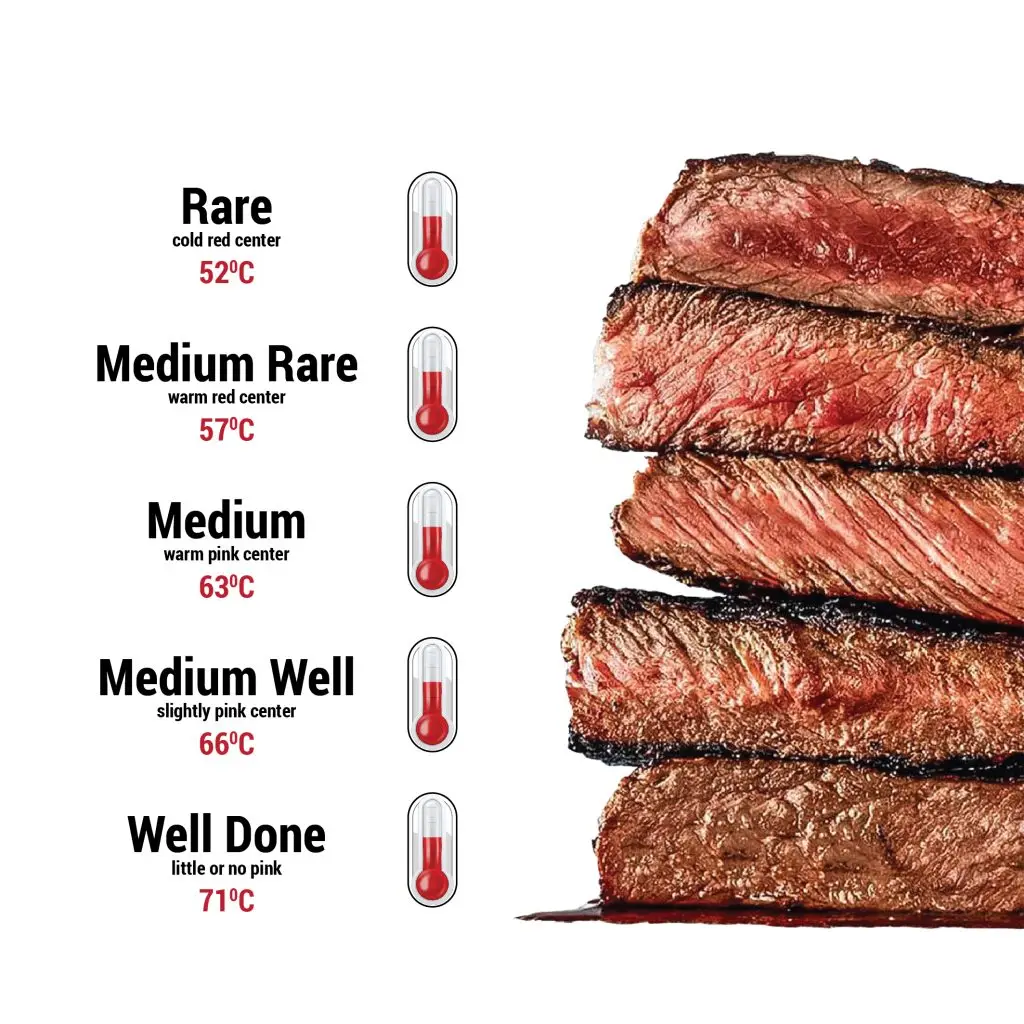
Select your preferred doneness below for the exact pull temperature, final resting temperature, and approximate timing for a 2–3cm steak.
Deep red centre throughout, very soft when pressed. The centre is barely warm. Sear 1.5–2 min each side at setting 7–8. Remove and rest immediately — carryover will finish it.
Warm red-pink centre, springy with a slight give when pressed. The most popular restaurant doneness. Sear 2–3 min each side, check temperature, pull when the probe reads 53–54°C.
Pink centre fading towards the edges, firmer texture. Sear 2.5–3 min each side, then reduce to setting 5–6 and continue for 1–2 more minutes if needed, checking with a thermometer.
Faint blush of pink at the very centre, quite firm to touch. After searing, reduce the heat to setting 4–5 and allow extra time for the heat to penetrate without drying the exterior.
Brown throughout, firm texture. Sear as normal then reduce to setting 3–4 for an extended low-heat finish. Keep checking the thermometer — at this doneness level it is easy to dry the steak out completely if it goes even a few degrees over.
These times are for a 2–3cm steak at room temperature in a properly preheated pan. A steak straight from the fridge will take 20–30% longer. Always use an instant-read thermometerA probe thermometer that gives a temperature reading within 2–3 seconds of insertion. Insert into the thickest part of the steak, away from the outer edge, for the most accurate reading of the true centre temperature. rather than relying on timing alone — thickness, starting temperature, and pan material all affect the result.
Best cuts of steak for cooking on an induction hob
Ribeye
High fat marbling bastes the meat during cooking, producing rich flavour and a forgiving texture. Well suited to induction as it stays juicy even at slightly higher temperatures. Ideal for medium-rare to medium.
Sirloin
A good balance of flavour and leanness with a fat cap along one edge. Sear the fat cap by standing the steak on its edge for 20–30 seconds. Best at medium-rare.
Rump
More flavour than fillet, less fat than ribeye. A slightly firmer texture that benefits from not being cooked past medium. Good value and widely available.
Fillet
The most tender cut with the least fat. Cooks quickly and can dry out easily. Use a thermometer carefully — fillet goes from perfect to overdone fast. Consider the reverse-sear for thick fillets (4cm+).
Flat iron
Increasing in popularity and excellent value. Uniform thickness makes it easy to cook evenly on induction. Suited to medium-rare; gets tough at higher temperatures.
Tomahawk / T-bone
Very thick cuts (4cm+) that require the reverse-sear method for even cooking. The large size suits a big cast-iron pan or griddle. An impressive centrepiece.
Step-by-step: how to cook steak on an induction hob
Bring the steak to room temperature
Remove the steak from the fridge 20–30 minutes before cooking. A cold steak placed in a hot pan causes an immediate and dramatic temperature drop in the pan surface, reducing the searing effect and producing a more uneven cook. Room temperature meat reaches its target internal temperature more predictably and in less time.
Pat completely dry and season generously
Use paper towels to dry the steak thoroughly on all surfaces. Any surface moisture turns to steam when it hits the hot pan, and steam prevents the Maillard reaction from occurring — the steak will grey and steam rather than brown and sear. Season with flaky salt and freshly ground black pepper immediately before cooking (or dry-brine by salting 40+ minutes ahead and leaving uncovered in the fridge, which draws moisture out then reabsorbs it).
Preheat the pan on high for 2–3 minutes
Set the induction zone to setting 8–9. Allow the pan to heat for a full two to three minutes with no oil. Cast iron needs slightly longer — three to four minutes. Add a thin film of high-smoke-point oil (rapeseed or groundnut) only once the pan is hot. The oil should shimmer and just begin to smoke. If it smokes heavily and immediately, reduce by one setting.
Do not add oil to a cold pan — it will overheat unevenly.Place the steak away from you and do not move it
Lay the steak in the pan, pressing gently across the surface to ensure full contact with the base. Resist moving it. The steak will initially stick to the pan — this is normal. Once the crust has formed, it will release naturally. Moving it too early tears the forming crust and reduces colour. If your hob setting is correct, you should hear a sustained, vigorous sizzle from the moment the steak hits the pan.
Sear the first side, then flip once
For a 2–3cm steak at medium-rare, sear for 2–3 minutes on the first side. Flip once using tongs. Do not press the steak down — this squeezes juices from the meat. Reduce the setting by one (to 6–7) and sear the second side for a further 2–3 minutes. Check the temperature with a probe thermometer inserted into the thickest part.
Sear the fat cap and edges if present
If the steak has a fat cap along its edge (sirloin in particular), hold the steak on its side using tongs for 20–30 seconds to render the fat and give it colour. This prevents a chewy, uncooked strip of fat along the edge of the finished steak.
Baste with butter and aromatics (optional)
Reduce to setting 5 and add a knob of butter with a crushed garlic clove and a sprig of thyme or rosemary. As the butter melts and foams, tilt the pan slightly and spoon the foaming butter over the top of the steak repeatedly for 30–60 seconds. This adds richness, colour, and flavour. Add butter only at this late stage — adding it earlier causes the milk solids to burn before the steak is cooked.
Rest for 5–7 minutes before cutting
Transfer the steak to a warm plate and leave it uncovered (or loosely tented with foil) for five to seven minutes. During cooking, the heat drives moisture towards the centre of the meat. Resting allows the muscle fibres to relax and the juices to redistribute evenly. Cut too soon and the juices run immediately onto the board rather than staying in the meat.
The internal temperature rises 2–3°C during resting — this is carryover cooking.Induction hob heat settings for steak
Induction hobs typically have settings from 1 to 9 (or 1 to 12 on some models), with some including a Boost or P mode above the maximum numbered setting. The table below maps settings to tasks using the most common 1–9 scale. If your hob uses a different scale, adjust proportionally.
| Task | Setting (1–9 scale) | Duration | Notes |
|---|---|---|---|
| Preheat empty pan | 8–9 | 2–3 min (cast iron: 3–4 min) | No oil yet. Pan is ready when a drop of water evaporates immediately. |
| Sear first side | 7–8 | 2–3 min | Do not move the steak. Listen for sustained vigorous sizzle. |
| Sear second side | 6–7 | 2–3 min | Reduce slightly to avoid scorching the second side while first side continues to cook through. |
| Butter basting | 5 | 30–60 sec | Lower heat prevents butter solids burning. Tilt pan and spoon continuously. |
| Finishing thick cuts | 3–4 | 1–4 min | Gentle heat to bring centre to target temperature without further browning the exterior. |
How to cook thick steak on induction: the reverse-sear method
For steaks 4cm or thicker — tomahawk, thick-cut fillet, large ribeye — the conventional sear-first approach creates a problem: by the time the centre reaches the target temperature, the exterior has been cooking at high heat for so long that a thick band of overcooked grey meat forms around the outside of the steak, with only a small window of the desired pink in the centre.
The reverse-sear solves this by inverting the process. The steak is cooked slowly at low heat first to bring the entire piece to just below the target temperature, and then seared briefly at maximum heat to create the crust. Because the steak’s interior is already at temperature before it hits the hot pan, the sear takes only 60–90 seconds per side — not long enough to overcook the outer layers.
Reverse-sear on induction: step by step
Place the steak in the cold pan, set the zone to setting 2–3, and cook slowly, turning every four to five minutes, until the internal temperature reaches approximately 5°C below your target doneness. For medium-rare this means pulling from the low heat at around 48–49°C. Remove the steak and rest it on a board for five minutes — the internal temperature will stabilise.
While it rests, increase the zone to setting 9 and preheat the pan until it is extremely hot (three to four minutes for cast iron). Add a thin film of oil, then sear the steak for 60–90 seconds per side and briefly on the fat cap. The crust will form rapidly over the already-cooked meat. Rest for a further two to three minutes, then serve.
The total cooking time is longer than a conventional sear, but the result is an edge-to-edge consistent doneness across the full thickness of the steak, combined with a deep, properly browned crust.
Why is my steak not browning on an induction hob?
A pale grey exterior instead of a deep brown crust is the most common complaint when cooking steak on any hob type, and it almost always comes down to one of three causes.
| Problem | Cause | Fix |
|---|---|---|
| Pale grey crust | Steak surface was damp when it hit the pan | Pat completely dry with paper towels immediately before cooking. Any surface moisture becomes steam, which prevents the Maillard reaction. |
| No sizzle when steak goes in | Pan not properly preheated | Preheat on setting 8–9 for at least two minutes (three for cast iron). The steak should sizzle loudly and immediately on contact. |
| Even colour but no crust depth | Pan temperature dropped when steak was added | Use a heavier pan (cast iron is best). A thin pan loses heat rapidly when cold meat is placed in it. Do not overcrowd the pan — one steak per zone. |
| Steak sticks and tears | Moved too soon before crust has formed | Leave completely undisturbed. A forming crust sticks; a formed crust releases. If it resists, wait another 30 seconds and try again. |
| Exterior burns, interior raw | Heat too high or steak too thick for conventional method | Reduce setting to 6–7 after searing, or use the reverse-sear method for steaks over 4cm thick. |
Frequently asked questions
Yes, and in many cases a better one than on gas. Induction heats the pan’s base evenly across the full contact area, whereas a gas burner produces more heat at the centre than the edges. With a properly preheated heavy pan, you will get a consistent deep brown crust across the full surface of the steak rather than a heavily browned centre with paler edges. The key is a pan with sufficient thermal mass (cast iron or quality tri-ply) and a proper preheat of at least two to three minutes.
On a standard 1–9 scale: preheat the empty pan on setting 8–9 for two to three minutes, then add oil and cook the first side at setting 7–8, dropping to 6–7 for the second side. Reduce to setting 5 if basting with butter. For finishing a thick steak through to temperature, drop to 3–4. Never use Boost or maximum power once the steak is in the pan — it will char the exterior before the interior is cooked.
For a 2–3cm steak at room temperature: rare is approximately two minutes per side, medium-rare two to three minutes per side, medium three minutes per side with a further one to two minutes on reduced heat. These are starting points rather than fixed rules — steak thickness, starting temperature, and pan weight all affect the result. Use an instant-read thermometer to verify the internal temperature rather than relying purely on timing.
Yes, regardless of the cooking method. Resting allows the muscle fibres to relax and the internal juices to redistribute from the centre back through the meat. Cut immediately and the juices run onto the board; rest for five to seven minutes and they stay in the steak. During resting, the internal temperature also continues to rise by 2–3°C (carryover cooking), which is why the pull temperature in the doneness guide is slightly lower than the target final temperature.
Use a high-smoke-point oil for the sear: rapeseed oil (smoke point around 230°C) and groundnut oil (around 230°C) are the most practical choices in the UK. Avoid olive oil or butter for the initial sear — both have low smoke points and will burn before the pan reaches searing temperature. Add butter only towards the end of cooking at a reduced heat setting, where its milk solids can brown without burning and where it adds flavour through basting.
You can, but it is not ideal. A cold steak causes a more significant temperature drop in the pan when it makes contact, which reduces the initial searing effect. It also takes longer to reach the target internal temperature, which means the exterior spends more time in the pan and risks overcooking. Removing the steak from the fridge 20–30 minutes before cooking produces more consistent results. The improvement is modest for thin steaks but noticeably better for thick ones.
Summary
Induction is an excellent choice for steak: even heat distribution, immediate power response, and compatibility with cast iron — the best pan for the job. The fundamentals are a fully preheated heavy pan, a completely dry steak surface, high heat for the sear, and a thermometer to hit your target internal temperature accurately. Rest for five to seven minutes before cutting.
For steaks over 4cm thick, the reverse-sear method produces the best edge-to-edge results: low heat to bring the centre to temperature first, then a brief high-heat blast for the crust. Pale results are almost always caused by insufficient preheat, a damp surface, or a pan with too little thermal mass — all straightforward to fix.
For more guidance on getting the best from your induction hob, explore the CATA hob guides and advice section.
Explore More Kitchen Advice & Buying Guides
Browse our latest articles covering appliance tips, energy-saving advice, and expert guidance – designed to help you choose, use, and get the most from your kitchen appliances.