Home » Hob Guides & Advice » 13 Amp Plug-In Induction Hobs: Pros and Cons Explained
13 Amp Plug-In Induction Hobs: Pros and Cons Explained
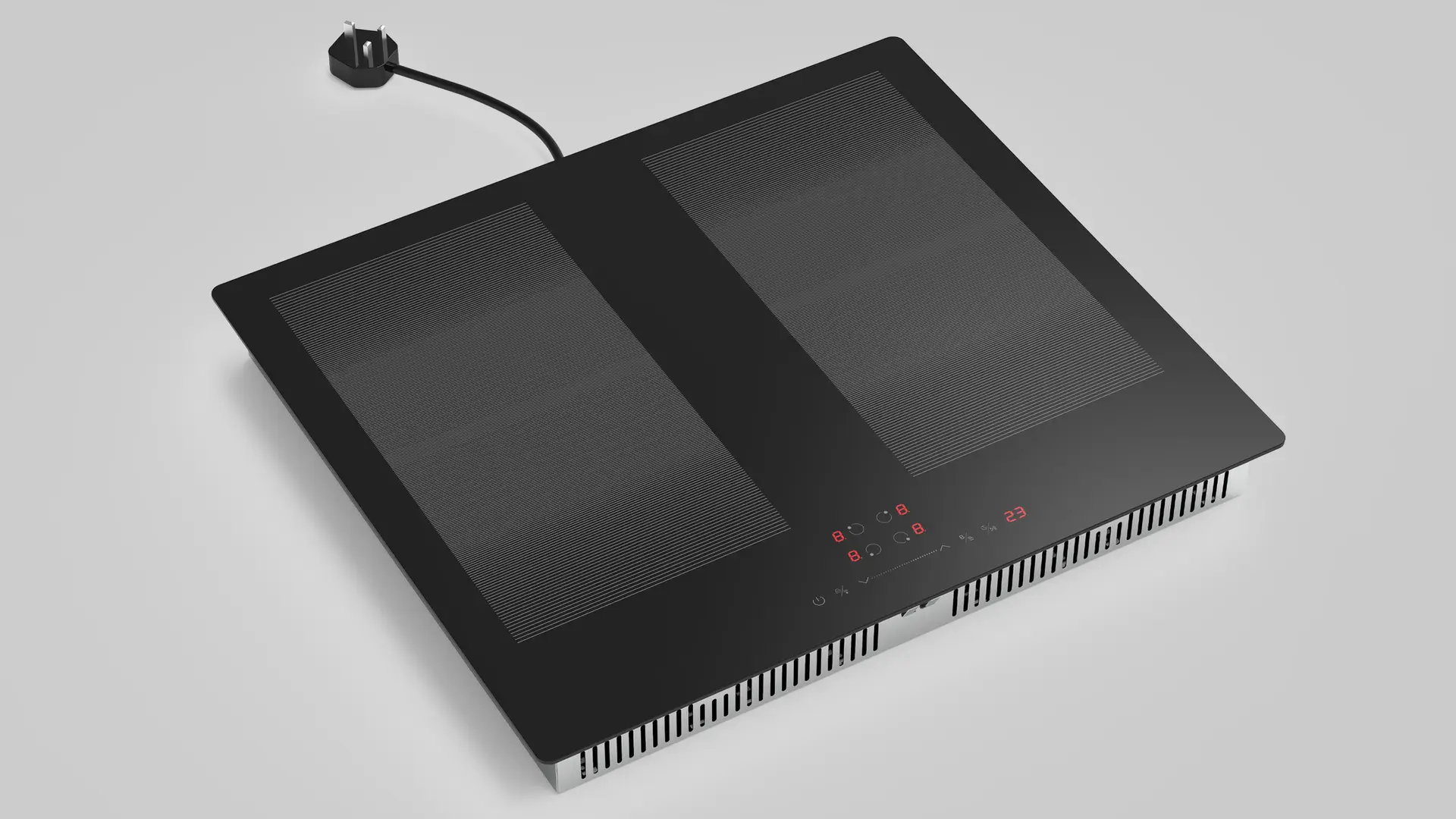
A 13 amp plug-in induction hob connects to a standard UK socket and requires no dedicated wiring or electrician. The trade-off is a total power output capped at around 2.8kW across all zones, compared to 7–11kW for a hardwired model. For small households, renters, and anyone who cooks with one or two pans at a time, that limitation rarely matters in practice.
Max total power output (13A)
Typical hardwired induction hob output
Standard UK socket rating
Electrician required for installation
What is a 13 amp plug-in induction hob?
Induction hobs use electromagnetic inductionAn alternating current in a copper coil beneath the glass creates a magnetic field. When a compatible ferrous pan is placed on the zone, the field induces an electrical current in the pan’s base, which generates heat directly in the metal. The glass surface itself stays relatively cool. to heat pans directly, rather than warming a surface that then conducts heat into the cookware. This makes them faster to heat up, more precise at low temperatures, and significantly more energy-efficient than ceramic or gas alternatives. The glass surface surrounding the active zone stays cool enough to touch, which also makes them inherently safer around children.
A standard built-in induction hob is hardwired to a dedicated high-amperage circuit, typically 32A or higher, which allows it to draw 7kW or more of power simultaneously across all zones. A 13 amp plug-in induction hob is engineered to operate within the limits of a standard UK three-pin socket and its associated 13A fuse. This means total power is capped at around 2.8kW — roughly what a kettle draws at full power — shared across however many cooking zones the hob has.
The result is an induction hob you can place on a worktop, plug into a standard socket, and use immediately with no installation work. That convenience is the primary reason people choose them, and for a significant proportion of users, the power limitation is a reasonable trade-off.
How does the 13 amp power limit actually work?
Understanding the power limit helps you judge whether a 13 amp hob will suit the way you actually cook, rather than just accepting “limited power” as an abstract drawback.
A 13A socket is rated to supply a continuous current of 13 amperes at 230 volts, giving a maximum power draw of approximately 2,990 watts (around 3kW). In practice, manufacturers build in a safety margin and rate their plug-in hobs at around 2.8kW to avoid tripping the fuse under normal use. That 2.8kW is a shared budget across all zones simultaneously.
On a two-zone hob, this might mean each zone gets a maximum of around 1.4kW when both are running at full power. On a four-zone model, the shared budget is divided further. Most hobs handle this through power managementAutomatic load balancing built into the hob’s electronics. When multiple zones are active, the hob redistributes available power between them to stay within the 13A limit, sometimes cycling power on and off rapidly at a rate imperceptible during normal cooking., which automatically redistributes available wattage between active zones. In practice, this means you can use all zones simultaneously at moderate settings without issue — you simply cannot run all of them at full boil simultaneously.
For everyday cooking — reheating, simmering, frying eggs, boiling pasta — this is rarely a noticeable constraint. Where it becomes apparent is when you need to bring multiple large pans to a rolling boil at the same time, or when cooking for a large group where all zones need to operate at high power concurrently.
Pros and cons of 13 amp plug-in induction hobs
✓ Pros
✕ Cons
13 amp vs 32 amp induction hobs: how do they compare?
The core difference between a 13A plug-in hob and a 32A hardwired hob is available power. Everything else — cooking technology, pan compatibility, precision, energy efficiency, and surface safety — is essentially identical. The question is whether the power difference matters for the way you cook.
| Feature | 13A plug-in | 32A hardwired |
|---|---|---|
| Installation | Plug into standard UK socket — no electrician needed | Requires a qualified electrician and dedicated circuit |
| Max total power | ~2.8kW across all zones | 7kW–11kW depending on model |
| Power per zone | Shared from 2.8kW total; typically 1.2–2kW per zone | Up to 3.7kW per zone (boost mode on some models) |
| Installation cost | None | Typically £150–£400 depending on circuit complexity |
| Cooking technology | Identical electromagnetic induction | Identical electromagnetic induction |
| Energy efficiency | 85–90% transfer to pan | 85–90% transfer to pan |
| Pan compatibility | Any induction-compatible cookware | Any induction-compatible cookware |
| Surface safety | Cool-touch glass outside active zone | Cool-touch glass outside active zone |
| Premium features | Basic to mid-range; fewer advanced functions | Full range including bridge zones, flex zones, boost |
| Best suited to | 1–2 person households, renters, secondary hobs | Families, regular high-output cooking, new kitchens |
Socket and circuit requirements: what you need to know
The plug-and-play nature of a 13A hob is its main selling point, but it is worth understanding what “standard socket” means in practice to avoid problems.
A 13A induction hob draws close to its maximum rated current continuously during use. It should be connected to a socket that is not being used simultaneously by other high-draw appliances. Running it on a shared extension lead alongside a kettle, microwave, or toaster risks tripping the circuit breaker.
Ideally, use a socket on its own ring main spur, or at minimum ensure no other high-wattage appliances are running from the same socket or extension at the same time.
The socket itself must be a correctly earthed, standard 13A UK socket in good condition. The hob should not be used with a two-pin adaptor, a travel adaptor, or any socket that shows signs of damage or overheating. The cable supplied with the hob should not be extended using a domestic extension lead for permanent use — extension leads are not rated for the continuous load a cooking appliance places on a circuit.
If your kitchen socket is on a circuit shared with other high-draw appliances, or if you are unsure about the condition or rating of your kitchen wiring, it is worth asking a qualified electrician to confirm suitability before using the hob regularly. This is not a complex check, but it is one worth making — particularly in older properties where kitchen circuits may not have been updated in line with current recommendations.
What cookware do you need for a plug-in induction hob?
The pan compatibility requirements for a 13A plug-in hob are exactly the same as for any other induction hob. Induction only works with cookware that contains a ferromagnetic baseA material that responds to a magnetic field — most commonly iron or magnetic stainless steel. Cast iron, carbon steel, and pans labelled ‘induction-compatible’ all work. Copper, aluminium, and non-magnetic stainless steel do not.: cast iron, carbon steel, and stainless steel pans marked as induction-compatible all work. Copper, plain aluminium, glass, and ceramic cookware do not, unless they have a magnetic base layer bonded to the bottom.
The simplest test is a fridge magnet: hold it against the base of the pan. If it sticks firmly, the pan will work on induction. A weak attraction or none at all means it will not.
If you are switching from gas or ceramic and need to replace cookware, this is worth factoring into the overall cost of moving to induction. Induction-compatible pans are widely available at all price points. Cast iron in particular works exceptionally well on induction and retains heat effectively for slow cooking, searing, and dishes that benefit from steady temperature.
For a broader overview of induction cooking and what to expect when switching from gas or ceramic, the CATA hob guides cover compatibility, cookware, and installation in detail.
Who should buy a 13 amp plug-in induction hob?
The right fit depends on household size, cooking habits, and practical circumstances. Here is an honest assessment of the situations where a plug-in hob works well and where it does not.
Renters and tenants
No hardwiring means no changes to the property. A plug-in hob can be taken when you move and used in any future rental without any installation work.
Single occupants and couples
Cooking one or two pans at a time rarely pushes the 2.8kW power budget. Most everyday cooking — boiling, frying, simmering — falls well within the available output.
Secondary or overflow cooking
A plug-in hob on a utility room worktop or kitchen island makes an excellent supplement to an existing main hob for batch cooking or entertaining.
Temporary or short-term kitchens
During a kitchen renovation, in a studio flat, or in a home office with a kitchenette, a plug-in hob provides induction cooking without any building work.
Small families (3–4 people)
Workable for straightforward family meals, but if you regularly cook multiple dishes simultaneously at high heat, the shared power budget may occasionally feel constraining.
Large households and frequent entertainers
If you regularly cook for four or more people and need all zones running at high power simultaneously, a hardwired 32A or higher hob will deliver a noticeably better experience.
Frequently asked questions
It should not, provided it is plugged into a dedicated socket and no other high-draw appliances are running from the same circuit at the same time. A 13A induction hob draws close to its maximum rated current during high-power cooking, which is within the rating of a standard UK socket. Problems arise when it is used on an extension lead shared with a kettle or microwave, or on a circuit that is already loaded close to its limit. If your circuit breaker trips during use, check what else is drawing power from the same circuit and ensure the hob has its own socket.
No. A 13 amp plug-in hob connects to a standard UK three-pin socket and requires no electrical work to install. You simply place it on a stable, heat-resistant surface, plug it in, and it is ready to use. The only time you might want to consult an electrician is if you are unsure whether your kitchen socket is on a suitable circuit for continuous high-draw use, or if you are considering adding a dedicated socket specifically for the hob in a kitchen where suitable ones are not conveniently positioned.
The cooking technology is identical. Both use electromagnetic induction to heat pans directly, both have the same energy efficiency advantage over gas and ceramic, both have cool-touch surfaces, and both require the same induction-compatible cookware. The meaningful difference is total available power: around 2.8kW shared across all zones on a 13A model, versus 7–11kW on a hardwired hob. For one or two pans at a time, the cooking experience is essentially the same. For high-output simultaneous cooking across multiple zones, the hardwired model delivers noticeably more power.
Yes, but the total power is shared across them. Most 13A hobs use automatic power management to balance output between active zones. You can use all zones simultaneously — you simply cannot run all of them at their individual maximum output at the same time. In practice, for everyday cooking like bringing a pan of pasta to the boil while sautéing vegetables and keeping a sauce warm, this is rarely a problem. It becomes noticeable if you need multiple large pans at a rolling boil simultaneously.
Any induction-compatible cookware. This includes cast iron, carbon steel, and magnetic stainless steel pans. Copper, plain aluminium, glass, and ceramic cookware will not work unless the base has a bonded magnetic layer. The quickest check is a fridge magnet held against the base of the pan: a firm magnetic attraction means it will work on induction. Most modern pans sold in the UK are either induction-compatible or clearly labelled if they are not.
Yes, in most cases. A plug-in hob does not require any modification to the property’s electrical system or fixtures. It is treated the same as any other plug-in appliance. Some tenancy agreements have restrictions on certain appliances, so it is worth checking yours if you are unsure. If your rental has a gas hob you are not permitted to remove, a plug-in induction hob works well as a supplementary cooking surface on the worktop alongside it.
They are often the same thing described differently. “Portable induction hob” and “13 amp plug-in induction hob” typically refer to the same category of appliance. The distinguishing features compared to single-ring portable induction plates (which are even lower powered) are that 13 amp hobs usually have two or more cooking zones, a flush glass surface, and power management across zones. Single-burner induction plates are often rated at 2kW or less and are designed for one pan only.
Summary
A 13 amp plug-in induction hob delivers all the core benefits of induction cooking — energy efficiency, fast precise heat, a safe cool surface — without requiring an electrician or dedicated wiring. The trade-off is a shared power ceiling of around 2.8kW across all zones, compared to 7–11kW on a hardwired model. For one to two person households, renters, and anyone who typically cooks with one or two pans at a time, this limit is rarely a practical constraint.
The technology is identical to a full-power hob. Pan compatibility requirements are the same. The cooking experience on individual zones is comparable. Where the difference shows is in high-output simultaneous cooking across multiple zones — if that describes your typical cooking, a hardwired 32A hob is the better fit. For everyone else, the convenience of a socket-ready installation makes a 13 amp plug-in hob a genuinely practical and cost-effective choice.
Explore More Kitchen Advice & Buying Guides
Browse our latest articles covering appliance tips, energy-saving advice, and expert guidance – designed to help you choose, use, and get the most from your kitchen appliances.