Home » Cooker Hood Guides & Advice » Carbon Filters vs Grease Filters Explained
Carbon Filters vs Grease Filters: What’s the Difference and Which Do You Need?
What each filter actually does
The two filters tackle two entirely separate problems, which is why one cannot substitute for the other.
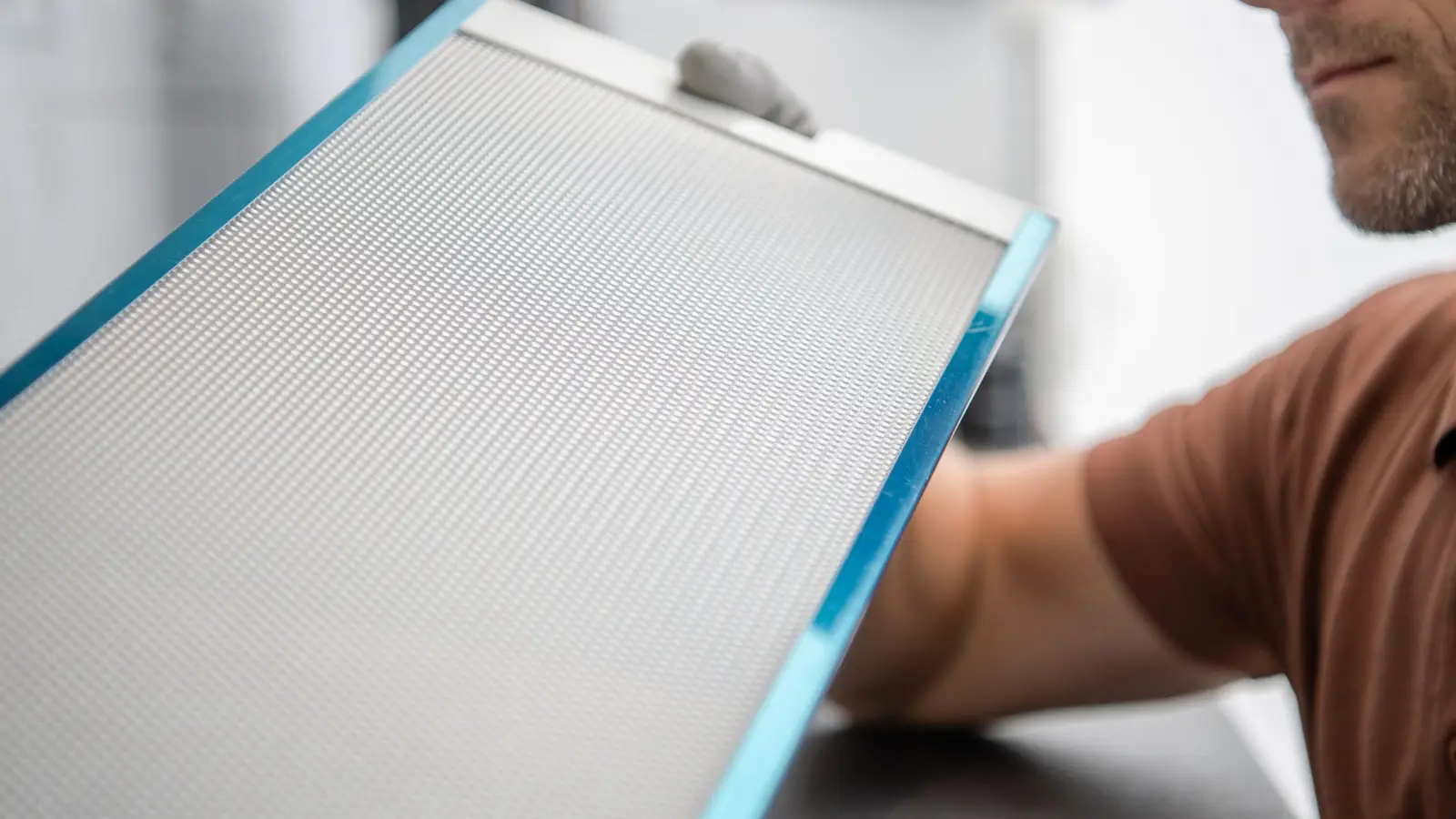
A grease filter is a physical barrier — typically aluminium mesh or stainless steel baffles — that sits directly beneath the fan. As cooking vapour rises, the filter forces air through a tight matrix of metal, where grease droplets cool, condense, and are trapped before they can reach the motor, the ductwork, or the internal surfaces of the hood. Without it, grease would accumulate inside the hood and eventually become a fire risk.
A carbon filter (also called a charcoal or activated carbon filter) does something different entirely: it removes odours. It sits above the grease filter, so the air reaching it has already had the bulk of its grease removed. As air passes through, activated carbonActivated carbon has an extremely porous surface that traps odour molecules via adsorption — binding them to the surface rather than absorbing them into the material. binds cooking smells — from frying, fish, onions, spices — to its surface, returning neutralised air to the kitchen. Carbon filters do nothing to capture grease, and grease filters do nothing to neutralise odours.
Ducted vs recirculating: which filters do you need?
The type of installation determines your filter setup. Most cooker hoods can be configured either way, and some are supplied with both grease and carbon filters pre-fitted — which catches people out when they install the hood in ducted mode and forget to remove the carbon filter.
A ducted hood draws air through the grease filter and expels it outside through a wall or ceiling duct. Because the air — and with it, any odours — leaves the building entirely, there is no need for a carbon filter. Only a grease filter is required.
If your hood is ducted and has a carbon filter fitted, remove it. A carbon filter adds resistance to airflow, which slightly reduces extraction power. Leaving it in when ducted means you are paying a performance penalty for no benefit. Check your hood’s manual to confirm whether it comes with a carbon filter pre-installed.
A recirculating hood has no external duct. It draws air through the grease filter, then through the carbon filter, and returns cleaned, deodorised air back into the kitchen. Both filters are essential — without the carbon filter, cooking smells will simply be blown back into the room.
Recirculating is the only viable option in many kitchens — flats, rooms on internal walls, or rented properties where ductwork cannot be installed. The trade-off is that the carbon filter needs replacing periodically, and a recirculating hood is inherently less effective at removing steam and moisture than a ducted equivalent.
Types of grease filter
Grease filters come in a few distinct materials, each with slightly different maintenance needs and performance characteristics.
Aluminium mesh filters
The most common type in domestic cooker hoods. Multiple layers of woven aluminium mesh create a dense barrier that forces rising air to change direction repeatedly, causing grease droplets to condense on the metal surface. They are durable, reusable, and can be washed by hand or in the dishwasher. Note that repeated dishwasher cycles can cause slight discolouration — this is cosmetic and does not affect performance.
Stainless steel baffle filters
Found on higher-specification hoods and professional-style appliances. Rather than mesh, baffle filters use a series of angled steel channels that deflect air sharply, forcing grease to separate out by centrifugal action. They are extremely durable and typically more effective at capturing grease at high cooking intensities. Baffle filters are dishwasher-safe and will not discolour.
Disposable paper or foam filters
Occasionally found on older or budget models. These are single-use filters that cannot be washed and must be replaced when saturated, typically every four to eight weeks depending on use. They are less common on modern hoods and are being phased out in favour of washable metal filters.
Common grease filter mistakes to avoid
- Leaving a saturated grease filter in place — grease buildup is a genuine fire hazard and will also cause the motor to work harder, shortening its lifespan
- Using bleach or caustic oven cleaners on aluminium mesh — these corrode the metal and can leave residue that affects air quality
- Reinstalling a wet filter — always allow filters to dry completely before refitting, as trapped moisture can encourage mould growth in the hood
- Using abrasive scourers — they scratch the mesh surface, making it harder to clean in future and trapping grease more deeply
How carbon filters work
Carbon filters use activated carbon — a form of carbon processed to have an extremely porous microstructure, creating a vast internal surface area. A single gram of activated carbon can have a surface area exceeding 1,000 square metres. When cooking air passes through the filter, odour-causing organic molecules are attracted to and bound to this surface — a process called adsorption (distinct from absorption, where molecules enter a material rather than adhere to its surface).
Once the pores are full, the filter is saturated and can no longer capture odours effectively. Standard carbon filters cannot be regenerated by washing — water does not dislodge the trapped molecules, and attempting to clean a standard carbon cassette will damage it. Some manufacturers offer long-life or washable carbon filters, which can be gently hand-washed and dried at a low oven temperature to partially reactivate the carbon. These can typically be regenerated six to eight times before needing replacement.
Cleaning and replacement schedule
The right maintenance frequency depends on how you cook. Someone who boils and steams most evenings will need to clean their grease filter far less often than someone who stir-fries or deep-fries regularly. The guidance below covers typical household use — adjust based on your own cooking habits and use any saturation indicators fitted to your hood.
Method: Soak in hot water with degreasing washing-up liquid for 10–15 minutes, then scrub gently with a soft brush. Most metal filters are also dishwasher-safe — use a hot cycle and allow to air dry fully before refitting.
Replace when: The mesh is visibly damaged, warped, or no longer clips securely into the hood.
Method: Standard cassettes are not washable — replace when saturated. Long-life filters can be hand-washed gently and dried at a low oven heat to reactivate, typically up to 6–8 times.
Replace when: Odours persist even with the hood running, or the manufacturer’s indicator light signals saturation.
For a full step-by-step guide to removing, cleaning, and refitting your grease filters, see our detailed cooker hood grease filter cleaning and replacement guide. And if you have a recirculating hood and want to understand carbon filters in greater depth, the carbon filters explained article covers sizing, long-life options, and what to do if your hood’s odour performance has declined.
Signs your filters need attention
Both filter types give fairly clear signals when they are past their best. The challenge is that people often tolerate a gradual decline in hood performance without connecting it to filter condition.
For the grease filter, the most obvious sign is visible saturation: the mesh looks dark, feels tacky to the touch, and may be visibly dripping with grease. A more subtle sign is increased motor noise — when the filter is clogged, the fan has to work harder to pull air through, which increases both noise and energy consumption. If your hood has always been quiet and has started sounding laboured, a blocked grease filter is the first thing to check.
For the carbon filter, the sign is simpler: cooking smells linger in the kitchen after you have finished cooking and the hood has been running. A well-functioning carbon filter should neutralise the bulk of odours within a few minutes of the hood being switched on. If fish smells are still noticeable an hour later, or if the kitchen consistently feels stale after cooking, the carbon filter is almost certainly saturated and needs replacing.
Frequently asked questions
Key takeaways
- Every cooker hood needs a grease filter — it protects the motor and prevents fire risk from grease buildup.
- A carbon filter is only needed in a recirculating hood. If your hood is ducted outside, remove any carbon filter fitted — it reduces airflow for no benefit.
- The two filters do completely different jobs: the grease filter traps particles mechanically; the carbon filter neutralises odours via adsorption.
- Grease filters are washable and reusable; standard carbon filters are not — they must be replaced every 3–6 months.
- Always match carbon filters to your specific hood model number. A poorly fitting cassette leaves gaps that allow unfiltered air to bypass the carbon.
- A lingering smell after cooking = carbon filter needs replacing. Increased motor noise or visible grease saturation = grease filter needs cleaning.
- Run the hood for 5–10 minutes after cooking to clear residual vapour and extend the life of both filters.
Explore More Kitchen Advice & Buying Guides
Browse our latest articles covering appliance tips, energy-saving advice, and expert guidance – designed to help you choose, use, and get the most from your kitchen appliances.