Home » Cooker Hood Guides & Advice » Do Cooker Hoods Remove Grease from the Air Effectively?
Do Cooker Hoods Remove Grease from the Air Effectively?
Yes — cooker hoods are specifically designed to capture airborne grease before it settles on your walls, cabinets, and surfaces. A well-maintained hood with clean filters removes the vast majority of grease particles produced during cooking, though effectiveness depends on the hood type, extraction rate, and how regularly the filters are serviced.
How Grease Capture Works in a Cooker Hood
When you cook, heat causes cooking oils and fats to atomise into microscopic droplets suspended in the rising steam and smoke. These droplets are small enough to travel across a room and deposit on any surface they contact — including paintwork, cabinet doors, and ceiling plasterwork. A cooker hood intercepts this plume of air before it disperses.
Airflow path through a cooker hood: grease particles are trapped by the mesh/baffle filter; carbon filters (recirculation models only) absorb odours before air is returned or vented outside.
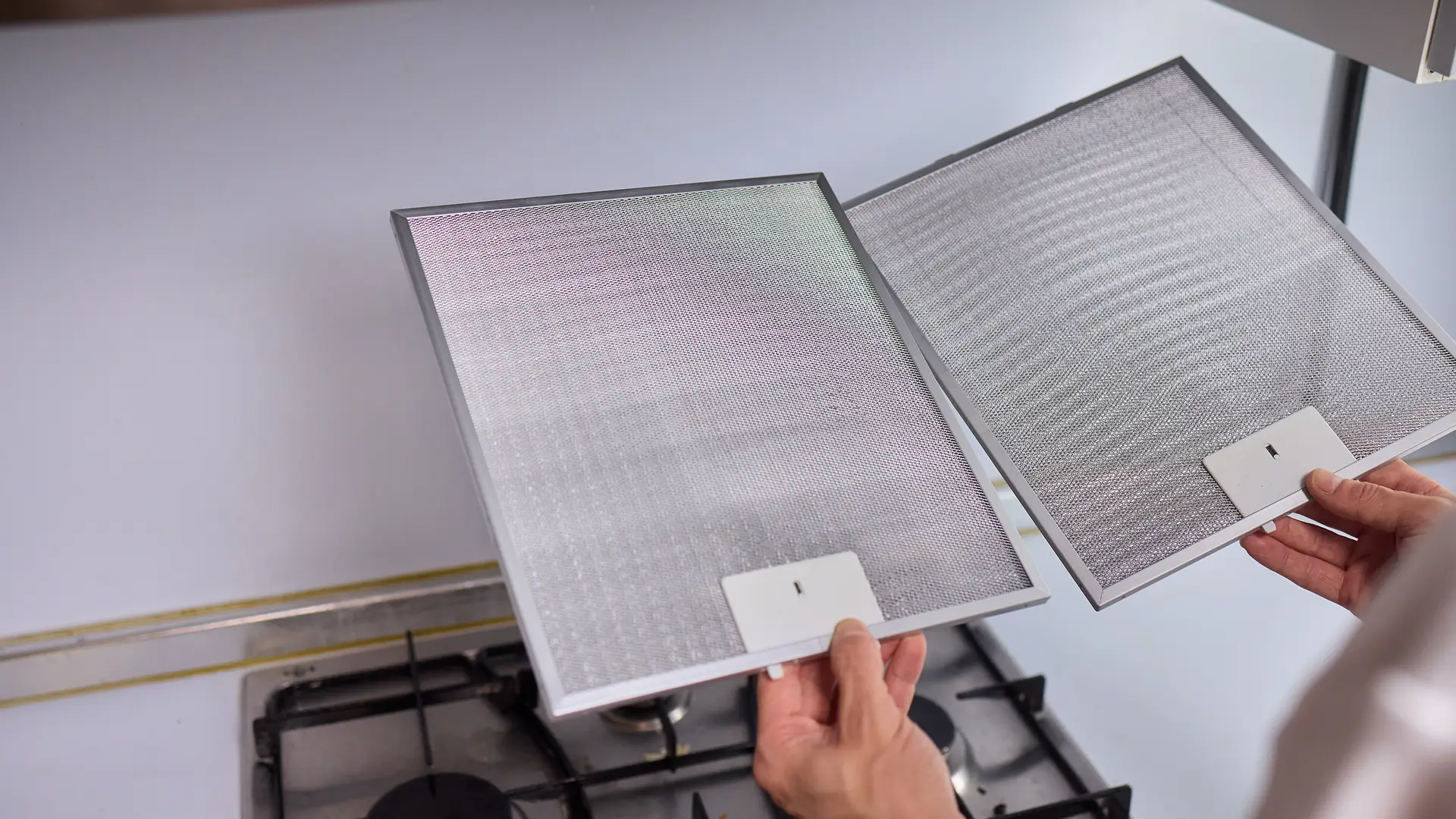
The fan draws cooking air upward through one or more filter layers. The grease filter — typically made from layered aluminium mesh or pressed stainless steel baffles — works by forcing the airstream to change direction rapidly. Grease droplets, being heavier than air, cannot follow those sharp turns and instead collide with the filter surfaces, where they condense and run into a collection channel. This mechanical process is highly effective: a clean, correctly sized grease filter captures the large majority of airborne fat particles before they reach the rest of the kitchen.
Filter Types Compared
Not all cooker hood filters do the same job. Understanding which filter handles grease and which handles odours helps you maintain your hood correctly — and explains why a hood that smells fine may still be distributing grease if the wrong filter is clogged.
| Filter type | Material | Removes grease | Removes odour | Washable | Replacement interval |
|---|---|---|---|---|---|
| Aluminium mesh | Layered aluminium | Yes | No | Yes | Wash monthly; replace if damaged |
| Baffle (stainless) | Pressed stainless steel | Yes — very effectively | No | Yes — dishwasher safe | Wash every 4–6 weeks; long service life |
| Carbon / charcoal | Activated carbon | Partial | Yes | No — replace only | Every 3–6 months (recirculation models) |
| Synthetic fibre | Polyester/fibreglass | Yes | No | No — replace only | Every 2–3 months or when visibly saturated |
Baffle filters are widely considered the most effective mechanical grease filter available for domestic hoods. Their pressed-steel construction creates a series of angular channels that dramatically change the direction of airflow, causing grease to separate out very efficiently. They also hold up well to repeated dishwasher cleaning, making them the lowest-maintenance option over time.
Extraction vs Recirculation: Which Removes More Grease?
Both types of hood can remove grease effectively — but they do so differently, and the distinction matters for how much residual grease and moisture remains in your kitchen after cooking.
Ducted (extraction) hoods
A ducted hood draws air through the grease filter and expels the treated air outside the building via a duct. Because the air — along with any remaining moisture and fine particles that passed through the filter — leaves the kitchen entirely, ducted extraction is the most thorough method. Steam, residual odour, and micro-particles of grease all exit through the duct rather than cycling back into the room. If you cook regularly with high heat or do a lot of frying, a ducted hood gives you the cleanest result.
Recirculating hoods
A recirculating hood passes air through a grease filter first, then through a carbon (activated charcoal) filter to absorb odours, before returning the air to the kitchen. Grease removal through the mechanical filter stage is essentially equivalent to a ducted hood — it is the carbon filter that handles odours, not grease. However, the moisture and any very fine particles that made it past the filters remain in the room. In a well-ventilated kitchen, this is rarely a problem. In a sealed space with poor background ventilation, moisture can accumulate and, over time, fine grease residue may still reach nearby surfaces.
If you are installing a recirculating hood, make sure the kitchen has adequate background ventilation — a trickle vent or openable window — to manage moisture and meet Building Regulations Part F requirements. Guidance is available at GOV.UK Approved Document F.
For a detailed breakdown of how these two approaches compare in practice, the CATA guide to recirculating vs ducted cooker hoods covers installation considerations, running costs, and which is better suited to different kitchen layouts.
When Cooker Hoods Struggle to Remove Grease
A cooker hood is only as effective as its setup and condition allow. There are several situations where even a well-specified hood will underperform on grease removal.
Filters that are overdue for cleaning
A clogged grease filter is the single most common cause of poor performance. As the mesh or baffle fills with captured fat, airflow through the filter is restricted. The fan has to work harder to draw the same volume of air, and more grease bypasses the filter entirely as air takes the path of least resistance around the blocked areas. A filter that was highly effective when clean can become almost counterproductive when neglected — the reduced airflow means the hood fails to capture the rising cooking plume before it disperses sideways into the room.
Underpowered extraction rate
A hood’s extraction rate — measured in cubic metres per hour (m³/hr) — describes how much air it can move. If the hood is too small or too underpowered for your cooking habits, the rising plume will spill past the edges before the fan can pull it in. As a guide, a hood should be able to cycle the volume of the kitchen air at least ten times per hour on its highest setting. This is covered in more detail in our guide to choosing the right cooker hood size.
Incorrect installation height
Fitting a hood too high above the hob is a surprisingly common issue. Most manufacturers specify a minimum and maximum clearance height — typically 65–75 cm above a gas hob and 55–65 cm above an electric or induction hob. Fitting higher than the recommended range means the cooking plume has more distance to spread laterally before reaching the hood’s intake zone, reducing capture efficiency significantly.
Airflow obstructions
For ducted models, any restriction in the ductwork reduces the effective extraction rate. Long duct runs, too many bends, undersized ducting diameter, or a blocked external wall vent all reduce the volume of air the hood can move — and therefore how much grease it can capture. Rigid round ducting in the largest diameter your installation allows gives the best flow.
Maintenance Dos and Don’ts
Consistent maintenance makes a larger difference to grease removal performance than almost any other factor. These are the habits that keep a cooker hood working as intended.
Do
- Wash aluminium mesh filters monthly in hot water with degreasing washing-up liquid or in the dishwasher
- Clean baffle filters every four to six weeks — most are dishwasher safe
- Replace carbon filters every three to six months on recirculating models, regardless of visible appearance
- Run the hood on a higher speed setting when frying, grilling, or using the wok burner
- Switch the hood on two to three minutes before you start cooking to establish airflow
- Leave the hood running for five to ten minutes after cooking to clear residual steam and particles
- Wipe down the hood’s external surfaces and canopy monthly to prevent grease build-up on the bodywork
Don’t
- Run a visibly saturated or discoloured filter — clogged filters reduce airflow and grease capture sharply
- Use a recirculating hood without a carbon filter fitted — it will only move grease-laden air around the room
- Attempt to wash a carbon filter — activated charcoal cannot be regenerated by rinsing and washing destroys it
- Ignore a drop in suction — reduced airflow is almost always a sign the filters need attention
- Cook on maximum hob heat with the hood on its lowest speed setting
- Block the air return vents on a recirculating hood — restricted return flow reduces suction throughout the system
Frequently Asked Questions
Yes, to a significant degree. A properly sized and well-maintained cooker hood intercepts the rising plume of grease-laden air before it disperses into the kitchen. Without a hood, or with a clogged one, airborne grease settles on every surface within range — walls, cabinets, ceilings, and nearby appliances. Regular filter cleaning is essential to maintaining this protection.
For most households cooking daily, monthly cleaning is the right interval. If you do a lot of high-heat cooking — frying, grilling, stir-frying — clean every two to three weeks. The filters on some hoods have a grease saturation indicator that changes colour when cleaning is overdue, but visible discolouration or reduced suction are reliable signs regardless.
Baffle filters made from stainless steel are almost always dishwasher safe and clean very effectively at high temperatures. Aluminium mesh filters can usually be washed in the dishwasher, though the alkaline detergent may dull the finish over time — hand washing in hot degreasing liquid works just as well. Always check your specific model’s manual first. Carbon filters must never go in the dishwasher.
For grease specifically, yes — both types use the same mechanical grease filter principle, so capture rates are comparable when filters are clean. The meaningful difference is that a ducted hood also removes moisture and fine odour particles from the room entirely, whereas a recirculating hood returns treated air to the kitchen. If grease removal is your primary concern and you keep filters maintained, either type will protect your surfaces adequately.
Persistent cooking odours are usually a sign that the carbon filter needs replacing (on recirculating models), that the extraction rate is insufficient for the volume of cooking, or that ductwork is restricted. On ducted hoods, odour retention can also indicate a blocked or poorly sealed external vent allowing air to flow back in when the hood is off. Fitting a non-return valve in the duct prevents this.
For maximum grease removal, a ducted hood fitted with baffle filters offers the best combination of mechanical capture efficiency and whole-room air clearance. Baffle filters outperform aluminium mesh in high-grease cooking scenarios and are more durable over repeated cleaning cycles. Island hoods and chimney hoods tend to offer the highest extraction rates where installation allows.
Summary
Cooker hoods are highly effective at removing airborne grease when correctly installed and maintained. The key points to carry away:
- Grease is captured mechanically by mesh or baffle filters — not by carbon filters, which handle odour only.
- Baffle filters offer the best grease capture and are the most durable for regular cleaning.
- Both ducted and recirculating hoods remove grease comparably; ducted hoods additionally remove moisture and odours from the room.
- Clogged filters are the most common cause of poor performance — monthly cleaning is the minimum for most households.
- Correct installation height and adequate extraction rate are critical to capturing the cooking plume before it disperses.
- Carbon filters on recirculating hoods must be replaced every three to six months and cannot be washed.
Explore More Kitchen Advice & Buying Guides
Browse our latest articles covering appliance tips, energy-saving advice, and expert guidance – designed to help you choose, use, and get the most from your kitchen appliances.