Home » General Appliance Guides & Advice » Do Induction Hobs Scratch Easily?
Do Induction Hobs Scratch Easily? Causes, Prevention & Fixes
What Is an Induction Hob Surface Made From?
The cooking surface on an induction hob is made from glass-ceramicA material combining glass aesthetics with ceramic-level thermal stability and strength, not standard glass. The most widely used glass-ceramic in the industry is manufactured by SCHOTT and sold under the brand name CERAN®. It has been the dominant material for cooking surfaces since its introduction in 1971 and is used by the vast majority of hob manufacturers worldwide.
Glass-ceramic is engineered to handle the specific demands of a cooking environment. It withstands rapid and extreme temperature changes — SCHOTT CERAN® is rated for thermal shocks across a range spanning sub-zero temperatures up to 700°C — and it resists the constant mechanical stress of pans being placed on and lifted from it. At just 4 mm thick, it transfers heat efficiently while remaining dimensionally stable under load.
What glass-ceramic is not, however, is completely impervious to surface scratching. The material scores well on hardness scales and is considerably more scratch-resistant than ordinary glass, but fine surface marks can still develop over time if the hob is used or cleaned carelessly. Understanding what causes those marks is the first step to avoiding them.
What Causes Scratches on an Induction Hob?
The majority of scratches on induction hobs come from a small number of very common habits. None of them are inevitable — they are all preventable once you know what to look for.
How to Prevent Scratches on an Induction Hob
Scratch prevention comes down to a handful of consistent habits. None of them require significant effort — they just need to become second nature when cooking and cleaning.
Always lift pans, never slide them
This is the single most impactful change you can make. Lifting a pan — even to move it an inch across the hob — eliminates the friction that causes most scratches. It takes a fraction of a second longer than sliding, and the difference to your hob surface over months and years of cooking is significant.
Keep the hob surface clean before cooking
Before placing any pan on the hob, take a moment to wipe the surface with a damp cloth. This removes any grit, salt, or food particles that have landed on it since the last clean. Equally, wipe down pan bases before placing them on the glass-ceramic — particularly if they have been stored on a shelf where dust or debris can accumulate.
Act quickly on spills, especially sugary ones
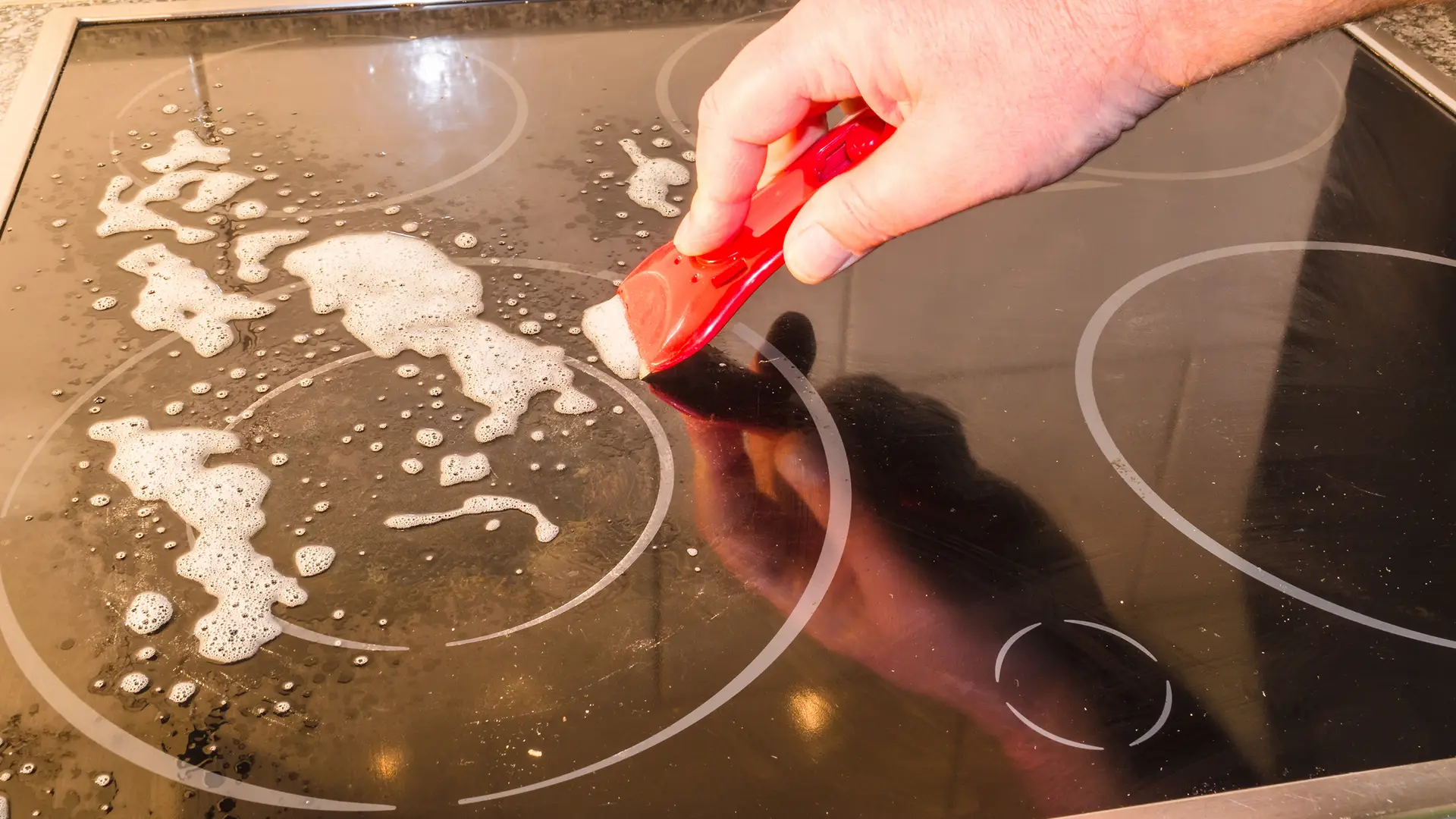
Sugary spills — jams, sauces, desserts, any food with a high sugar content — need to be removed promptly. When sugar melts onto the glass-ceramic surface and then cools, it bonds firmly and can cause permanent surface damage if scraped off incorrectly. Use a dedicated hob scraper at a shallow angle while the spill is still slightly warm, then clean the residue with a ceramic hob cleaner. Never wait until it has fully hardened.
Use the right cleaning products and tools
Dedicated ceramic hob cleanersNon-abrasive formulations designed specifically for glass-ceramic surfaces are formulated to lift grease and residue without scratching. For stubborn marks, a flat hob scraper blade held at a very low angle is effective and safe when used correctly. Avoid scouring pads, steel wool, cream cleansers with abrasive particles, and any general-purpose kitchen spray that is not specifically labelled safe for glass-ceramic surfaces.
Choose cookware with smooth, flat bases
Pans with smooth, flat, undamaged bases create less friction and distribute weight more evenly across the surface. For everyday cooking, this means avoiding cheap pans with uneven or textured undersides. Stainless steel, enamelled cast iron, and good-quality aluminium pans with flat bases are all well-suited to induction hobs. If you use heavy cast iron regularly, inspecting the base periodically for rough spots is worth doing.
⚠ Avoid these common mistakes:
- Dragging any pan across the surface, even briefly
- Cleaning with scouring pads, steel wool, or abrasive powders
- Leaving sugary or caramelised spills to fully harden
- Using the hob as an extra worktop or resting surface
- Placing pans on a dirty or gritty hob surface
- Scraping hardened food with metal implements at a steep angle
Can Scratches Be Removed from an Induction Hob?
The honest answer depends on how deep the scratch is. Very fine surface scuffs — the kind that appear as a dull haze or light cloudiness in certain light — can sometimes be reduced using specialist ceramic hob polishes. These products work by smoothing the finest surface irregularities and restoring some of the original shine.
Deeper scratches that you can feel with a fingernail are a different matter. The glass-ceramic surface is a single layer, not a coating over something else, so once a mark penetrates beyond the very surface level, there is no practical way to remove it at home. The scratch becomes a permanent feature of the hob.
What is worth keeping in mind is that most scratches are purely cosmetic. They do not affect how efficiently the hob heats, how quickly it responds to temperature changes, or how safely it operates. Unless the glass-ceramic is cracked or deeply chipped — which is a different category of damage altogether — a scratched hob is generally still a fully functional hob.
Are Induction Hobs More Scratch-Prone Than Ceramic Hobs?
This is one of the most common questions about induction hobs, and the short answer is: not really. Both induction and ceramic hobs use essentially the same glass-ceramic surface material. The difference between the two is what happens underneath — induction uses electromagnetic coils, ceramic uses radiant heating elements — but the surface you touch, cook on, and clean is materially very similar on both types.
If anything, induction hobs have a subtle advantage: because the surface itself does not generate heat directly, it stays cooler around the cooking zone during use. This means food spills are less likely to bake firmly onto the glass-ceramic, making cleaning somewhat easier and reducing the risk of burnt-on residue that requires aggressive scraping.
| Factor | Induction hob | Ceramic hob |
|---|---|---|
| Surface material | Glass-ceramic | Glass-ceramic |
| Inherent scratch resistance | Similar | Similar |
| Food baking onto surface | Less likely (cooler surface) | More likely (hot surface) |
| Risk from sliding pans | Same risk on both | Same risk on both |
| Cleaning ease | Generally easier | Moderate |
Do Scratches Affect How the Hob Works?
In the vast majority of cases, surface scratches have no effect on heating performance. Induction hobs generate heat through an electromagnetic field produced by coils beneath the glass-ceramic panel. The field passes through the surface to create eddy currents in the base of compatible cookware — and fine surface scratches do not meaningfully interfere with this process.
The exception is significant structural damage: deep chips, cracks, or areas where the glass-ceramic has fractured. These can potentially expose the electronics beneath to moisture and may affect the integrity of the panel itself. For surface scratches alone, performance impact is not a concern for most users.
Scratch Resistance as a Buying Consideration
If keeping your hob looking pristine long term is a priority, it is worth knowing that scratch resistance does vary between models — not just because of how the hob is used, but because of the specific glass-ceramic used in its construction.
SCHOTT, the company behind CERAN® glass-ceramic, offers a premium variant called CERAN Miradur® — the world’s first scratch-resistant glass-ceramic coating. According to SCHOTT’s own technical data, Miradur® achieves a universal hardness of approximately 10 GPa, which they describe as close to diamond hardness and three times that of stainless steel. Independent testing has shown it produces 95% fewer scratches from sand and 70% fewer scratches from abrasive sponges compared to standard glass-ceramic. It is available on a number of premium induction hob models from major brands.
For most households, a standard glass-ceramic surface is entirely adequate with sensible care. But if you cook heavily, have children in the kitchen, or simply want the reassurance of a more resilient surface, checking whether a hob uses an enhanced glass-ceramic is a worthwhile part of the buying decision.
If you are weighing up whether to use a protective mat on your hob surface, the CATA guide to induction hob protectors — pros and cons is a useful read before you decide.
For independent guidance on energy-efficient cooking appliances and how to get the most from them, the Energy Saving Trust’s kitchen energy advice provides straightforward, manufacturer-neutral guidance.
Frequently Asked Questions
Summary
- Induction hob surfaces are made from glass-ceramic — durable and heat-resistant, but not scratch-proof.
- The most common causes of scratches are sliding cookware, grit or salt trapped beneath pans, abrasive cleaning, and caramelised sugar spills left to harden.
- Most scratches are entirely preventable: lift pans rather than sliding them, keep surfaces clean before and after cooking, and use only dedicated hob cleaners.
- Fine surface scuffs can sometimes be reduced with a ceramic hob polish; deeper scratches are permanent but cosmetic only.
- Scratches do not affect heating performance or safety — cracking or chipping is a different matter and should be treated as a fault.
- Induction hobs are no more scratch-prone than ceramic hobs — they use the same surface material.
- Premium models with SCHOTT CERAN Miradur® glass-ceramic offer significantly enhanced scratch resistance if this is a priority when buying.
Explore More Kitchen Advice & Buying Guides
Browse our latest articles covering appliance tips, energy-saving advice, and expert guidance – designed to help you choose, use, and get the most from your kitchen appliances.