How Does a Fan Oven Work?
A fan oven works by using a fan, paired with a heating element, to circulate hot air evenly around the oven cavity. That constant airflow keeps the temperature consistent on every shelf, so food cooks faster and more evenly than in a conventional oven, and you can cook on several shelves at once.
Quick answer
A fan oven heats the air with an element, then a fan blows that hot air around the cavity so every shelf sits at the same temperature. The result is quicker, more even cooking with fewer hot spots. Because the heat is distributed so efficiently, you typically set a fan oven around 20°C lower than a conventional recipe temperature. Modern built-in ovens use this fan-assisted cooking for reliable everyday results.
What Is a Fan Oven?
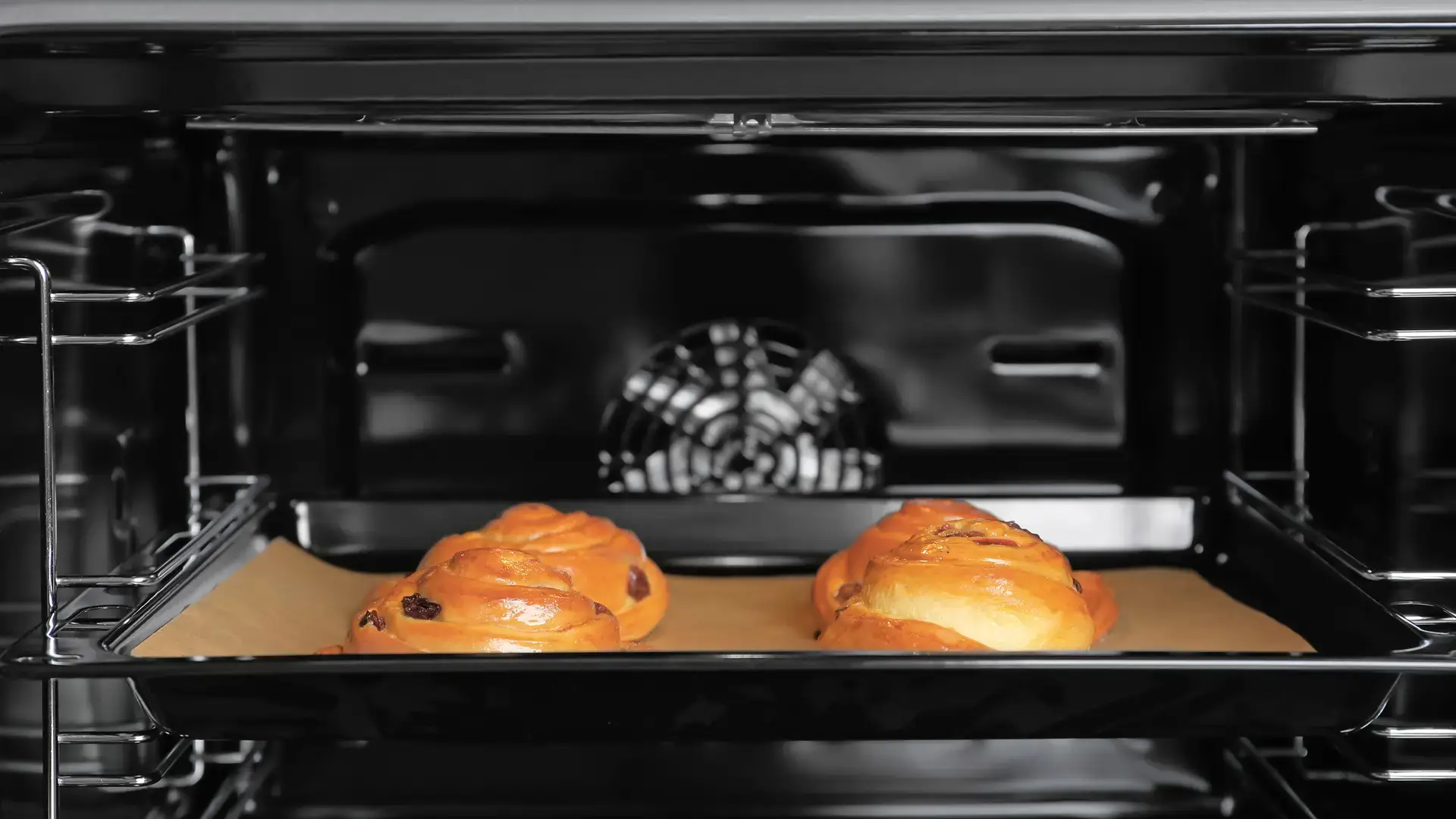
A fan oven, sometimes called a convection ovenAn oven that uses a fan to circulate hot air for even cooking. In the UK this is usually called a fan oven; in some regions it is called a convection oven., is designed to cook food evenly by moving hot air around the cavity. Unlike a conventional oven, which relies on heat radiating from the top and bottom elements, a fan oven uses a fan to push heat into every corner.
The fan sits at the back of the oven, and in a true fan oven a ring-shaped element around that fan heats the air before it is circulated. By keeping the temperature even throughout, a fan oven reduces hot and cold spots, which is why it is so well suited to baking and to cooking several dishes at once. If you ever notice patchy results, our guide on why an oven cooks unevenly is a useful companion read.
How a Fan Oven Works, Step by Step
- The element heats the air. When you set a temperature, the heating element warms up, usually the ring element surrounding the fan at the back.
- The fan circulates the heat. The fan spins to push that hot air evenly around the whole cavity, not just up from the base.
- A consistent temperature is held. The moving air keeps every shelf at the same temperature, preventing hot and cold spots.
- Cooking is faster and more efficient. Because heat reaches the food from all directions, it generally cooks more quickly than in a conventional oven.

Key takeaway: A fan oven does not just heat the air, it moves it. That constant circulation is what makes cooking more even, efficient and predictable.
Fan Oven, Fan-Assisted, or Conventional?
These terms are often mixed up, so it helps to know the difference.
- True fan oven. A ring element around the rear fan heats the air, which the fan then circulates. Best for even, multi-shelf cooking.
- Fan-assisted ovenUses the top and bottom elements for heat, with a fan circulating that heat around the cavity.. Uses the top and bottom elements, with a fan moving the heat around. A halfway point between the two.
- Conventional oven. Top and bottom elements only, with no fan, so heat tends to be stronger near the top.
Many modern ovens combine these as selectable functions, so you can switch between fan and conventional heat depending on the dish. To make sense of the symbols on your dial, see our guide to oven functions explained.
Key Benefits of a Fan Oven
- Even heat distribution. Every shelf gets consistent heat, so you can cook multiple dishes at once without uneven results.
- Faster cooking times. Circulating hot air reduces hot and cold spots and brings food up to temperature more quickly.
- Energy efficiency. Lower temperatures, shorter times and multi-shelf cooking can all help reduce energy use. See how to use residual oven heat to save energy for more.
- Versatility. Great for roasting, baking and reheating, which makes it a dependable all-rounder for everyday cooking.
Fan Oven Temperature Conversion
Because a fan oven distributes heat so efficiently, the standard guidance is to set it around 20°C lower than a conventional recipe, unless the recipe already gives a fan temperature. Cooking times can also be a little shorter, so check food a few minutes early. Use the chart below as a quick reference.
| Conventional oven | Fan oven | Gas mark |
|---|---|---|
| 150°C | 130°C | 2 |
| 170°C | 150°C | 3 |
| 180°C | 160°C | 4 |
| 190°C | 170°C | 5 |
| 200°C | 180°C | 6 |
| 220°C | 200°C | 7 |
| 230°C | 210°C | 8 |
If your oven readings ever seem off against these figures, an inaccurate thermostat may be to blame. Our guide on oven temperature accuracy explains how to check.
Common Uses and Best Practice Tips
Fan ovens shine wherever even heat and consistency matter most, such as roasting meat and vegetables, baking several trays of cookies or pastries together, and cooking casseroles and gratins without burnt edges.

- Reduce the temperature. Drop recipe temperatures by around 20°C unless a fan figure is already given.
- Still preheat. Fan ovens heat up quickly, but preheating matters for baking. See whether you can leave trays in while preheating.
- Do not overcrowd. Leave space between dishes so air can circulate freely.
- Use the right shelves. Spread dishes across shelves rather than stacking them tightly together.
Important: Good air circulation is the whole point of a fan oven. Blocking the airflow, for example by covering shelves completely or crowding trays, reduces efficiency and leads to uneven cooking.
That said, the fan is not always ideal. Very delicate bakes, such as some cakes and custards, can dry out or set unevenly in a strong draught, so many bakers switch to the conventional setting for those. A fan oven is also excellent for a Sunday roast, where even browning is a real advantage.
Fan Oven vs Conventional Oven
Knowing the difference helps you pick the right setting for the dish.
| Feature | Fan oven | Conventional oven |
|---|---|---|
| Heat distribution | Even, thanks to fan circulation | Less even, often hotter at the top |
| Cooking speed | Faster | Slower overall |
| Best for | Multi-shelf cooking and roasting | Single trays and some delicate bakes |
| Temperature | Set around 20°C lower | Use the recipe temperature |
| Consistency | More predictable shelf to shelf | May need turning or moving dishes |
Get more from your oven
Understanding the fan is just the start. These guides help you cook more evenly and run your oven efficiently.
- Decode every setting with oven functions explained
- Fix patchy results using why your oven cooks unevenly
- Browse fan-assisted models in the CATA oven range
Troubleshooting and FAQs
A steady whirring from the fan is normal while the oven runs. Loud rattling, grinding or unusual sounds can point to a loose fan blade or a worn motor that needs checking, so it is worth having it looked at if the noise changes.
Yes. Fan ovens heat up faster than conventional ovens, but preheating still helps deliver consistent results, especially for baking where a stable starting temperature matters.
Usually, yes. Set the oven around 20°C lower than a conventional recipe temperature, unless the recipe already gives a fan figure. Cooking times can be slightly shorter too, so check food a few minutes before the stated time.
Yes, and it is one of the biggest advantages of a fan oven. The even heat suits multi-shelf cooking, as long as the dishes need similar temperatures and you leave space for air to move between them.
A small fan icon selects the fan or fan-assisted setting. A circle with a fan inside usually means the true fan function with the rear element, while lines at the top and bottom indicate conventional heat. Your manual confirms exactly what each symbol does on your model.
They can be. Lower temperatures, shorter cooking times and the ability to cook several dishes at once all help reduce energy use compared with running a conventional oven for one tray at a time.
The moving air that makes a fan oven so even can also dry the surface of delicate dishes. Setting the temperature 20°C lower, covering dishes where appropriate, or switching to the conventional setting for sensitive bakes usually solves it.
Final Verdict
A fan oven cooks faster, more evenly and often more efficiently than a conventional oven by circulating hot air around the cavity. For most everyday cooking, it is the setting to reach for.
- The fan moves heated air so every shelf stays at the same temperature.
- Set it around 20°C lower than a conventional recipe.
- Ideal for roasting, baking and cooking several dishes at once.
- Switch to conventional heat for very delicate bakes.
- Keep air circulating by not overcrowding the shelves.