Recirculating vs Ducted Cooker Hoods: Which Is Best for Your Kitchen?
How Cooker Hoods Work
Every cooker hood does the same job: a fan draws in the warm, greasy, steam-laden air produced during cooking. What separates the two main types is what happens to that air next.
A ducted hoodAlso called an extraction hood or vented hood — pushes cooking air outside via a duct. channels air through a pipe to an external wall or roof outlet, removing it from the building entirely. A recirculating hoodAlso called a filterless, non-vented or ductless hood — cleans air through grease and carbon filters before returning it to the room. passes the same air through grease and carbon filters, then releases it back into the kitchen.
That single difference in airflow determines everything else about the two systems: installation complexity, running costs, how fresh your kitchen smells after a fish supper, and whether you need to worry about building regulations.
Recirculating Cooker Hoods: How They Work, Pros and Cons
A recirculating cooker hood draws air upward from the hob, passes it through a set of filters, and releases the cleaned air back into the kitchen. Nothing leaves the room. The filtration system typically uses two stages:
-
1
Grease filter — usually aluminium mesh, this catches airborne fat and oil particles. It is washable and should be cleaned roughly once a month.
-
2
Carbon (charcoal) filter — activated carbon absorbs cooking odours and some volatile compounds. Unlike the grease filter, carbon filters are not washable and need replacing every three to six months, depending on cooking frequency.
Because there is no duct penetrating an external wall, recirculating hoods can be installed almost anywhere — on an internal wall, above a kitchen island, or in a flat where the landlord prohibits structural changes.
Advantages of recirculating cooker hoods
- Simple installation. No brickwork, no ductwork, no specialist installer required in most cases. This keeps upfront costs low.
- Placement flexibility. Suitable for internal walls, kitchen islands, and properties where an external vent is impossible.
- Good for renters. Fitting a recirculating hood leaves no permanent changes to the property.
- No make-up air concerns. Ducted hoods expel large volumes of air, which must be replaced by fresh air entering the building. Recirculating hoods avoid this entirely, which can be useful in very well-insulated homes.
Disadvantages of recirculating cooker hoods
- Steam and moisture remain in the kitchen. Carbon filters do not remove water vapour, so humidity levels stay elevated during and after cooking. Over time this can cause condensation on windows and walls.
- Odour removal is limited. Filters reduce cooking smells but cannot match the thoroughness of venting air outdoors. Strong odours from frying, fish, or spicy dishes are the most likely to linger.
- Carbon filters need regular replacement. This is an ongoing cost and — if filters are left too long — performance drops sharply. Set a reminder.
- Can be noisier. The fan works against the resistance of filter media, which pushes noise levels up compared with a well-installed ducted system.
- Does not meet Part F building regulations on its own. See the building regulations section below for what this means in practice.
Ducted and recirculating models across every style — chimney, angled glass, integrated, island, and more.
Ducted Cooker Hoods: How They Work, Pros and Cons
A ducted cooker hood (also called an extraction hood or vented hood) captures cooking air above the hob and pushes it outside through a system of rigid or flexible ducting. The air leaves the building — taking odours, steam, and heat with it — and is not returned to the kitchen at any point.
How the air moves
-
1
The fan draws in air containing grease particles, steam, heat, and cooking smells.
-
2
A washable grease filter (aluminium mesh) traps fat particles, protecting the motor and preventing grease from building up inside the ductwork.
-
3
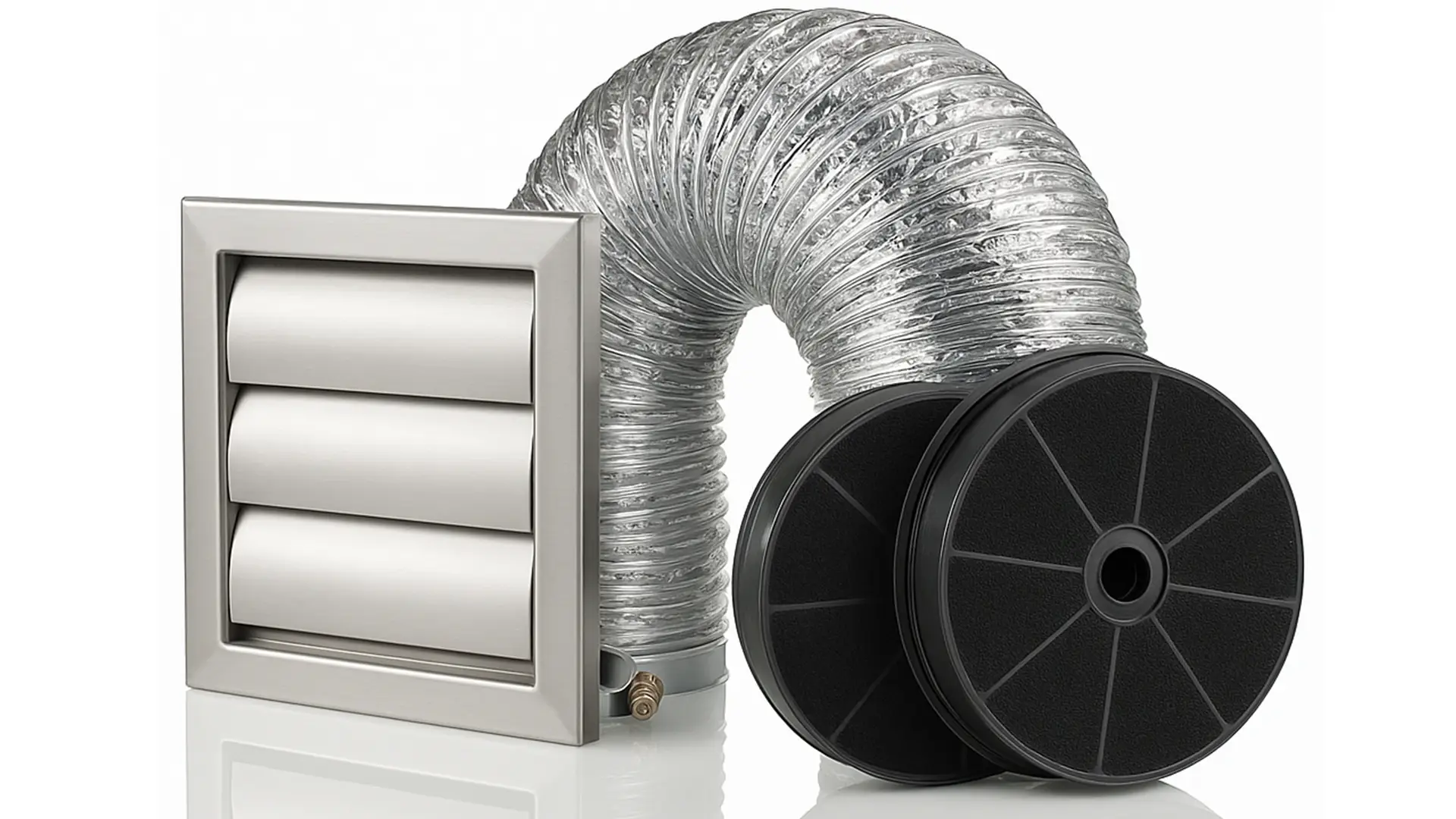
The remaining air is pushed along a ductIdeally 150 mm diameter, rigid, with as few bends as possible. Each 90° elbow can reduce airflow by the equivalent of 1–2 metres of straight duct. to an external wall or roof outlet.
-
4
Air exits the building. Fresh air naturally enters through trickle vents, windows, or passive inlets, replacing what has been removed.
Advantages of ducted cooker hoods
- Superior odour removal. Smells leave the building rather than being filtered and redistributed into the room.
- Removes steam and moisture. Ducted extraction keeps humidity in check, significantly reducing condensation on windows and surfaces — particularly important in kitchens attached to living areas.
- Removes excess heat. Hot cooking air exits the building, making the kitchen noticeably cooler during sustained frying or oven use.
- Lower long-term running costs. No carbon filters to replace — just periodic cleaning of the grease filter.
- Quieter in practice. When ducting is short, straight, and the correct diameter, a ducted hood can be significantly quieter than an equivalent recirculating model.
- Complies with Approved Document F as the primary kitchen ventilation method.
Disadvantages of ducted cooker hoods
- Higher installation cost. Running ducting through walls or ceilings requires careful planning and, usually, a professional installer.
- Requires external access. Not always feasible in flats, listed buildings, or kitchens on internal walls of large houses.
- Performance is ductwork-dependent. Long runs, multiple bends, flexible hose, and undersized pipes all reduce airflow. A poorly designed ducted installation can actually underperform a good recirculating hood.
- Make-up air is needed. Every litre of air expelled must be replaced. In very airtight homes this can cause negative pressure, making doors hard to open and drawing air through gaps in undesirable places.
- Never reduce duct diameter along the run — this increases back-pressure and noise.
- Avoid flexible corrugated hose if possible: grease collects in the ridges and it restricts airflow. If you must use it, pull it fully taut.
- Limit bends to the minimum necessary — each 90° elbow loses roughly 1–2 metres of effective duct length.
- Always fit a non-return valve at the external outlet to prevent wind blowing back down the duct.
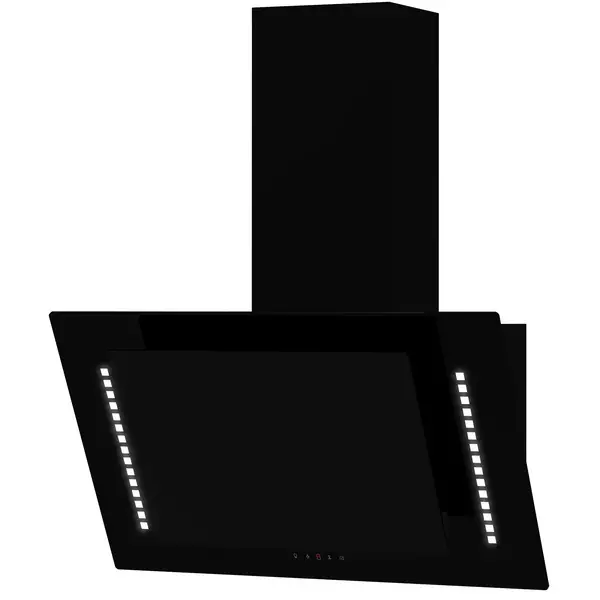
Available in ducted and recirculating modes. 60 cm width, black finish.
Side-by-Side Comparison
Here is every practical consideration placed directly alongside one another, so you can see which type comes out ahead for the factors that matter most to you.
| Factor | Recirculating hood | Ducted hood |
|---|---|---|
| Installation | No ducting needed. Suitable for internal walls and flats. | Requires external wall or roof access. More involved. |
| Installation cost | ✔ Lower upfront | ↑ Higher upfront |
| Odour removal | Moderate — reduced but not eliminated | ✔ Excellent — expelled outside |
| Steam & moisture | ↑ Remains in kitchen | ✔ Removed entirely |
| Condensation risk | ↑ Higher | ✔ Lower |
| Heat removal | None — heat stays in the room | ✔ Heat vented outside |
| Running costs | Carbon filter replacement every 3–6 months | ✔ Lower — grease filter cleaning only |
| Noise | Often noisier — fan works against filter resistance | Quieter when ductwork is well designed |
| Building regulations | Does not count as extract ventilation under Part F | ✔ Meets Part F requirement at ≥30 l/s |
| Maintenance | Monthly grease filter clean + regular carbon filter replacement | Monthly grease filter clean only |
| Best for flats | ✔ Yes | Only where external access exists |
| Best for open-plan | Not recommended | ✔ Yes |
| Gas hob compatibility | Suitable, but no combustion by-product removal | ✔ Removes combustion by-products |
What Extraction Rate Do You Need?
Extraction rate — measured in cubic metres per hour (m³/h) or litres per second (l/s) — tells you how quickly a hood can cycle the air above your hob. Buying a hood that is underpowered for your kitchen is one of the most common mistakes people make.
How to calculate the minimum rate for your kitchen
A widely used rule of thumb is to multiply your kitchen’s air volume by ten — that is, the hood should be capable of exchanging all the air in the room ten times every hour. For gas hobs, some installers recommend increasing this to twelve air changes.
To find your kitchen’s volume, multiply length × width × ceiling height (all in metres). Then multiply by 10. The result is your minimum extraction rate in m³/h.
Example: A kitchen that measures 4 m × 3.5 m × 2.4 m has a volume of 33.6 m³. Multiplied by 10, you need at least 336 m³/h. That equates to roughly 93 l/s.
Under Approved Document F, the minimum for a ducted cooker hood mounted directly above the hob is 30 l/s (108 m³/h). This is a regulatory floor, not a performance target — for a full-size kitchen with a gas hob, you will generally want considerably more than this.
Adjustments to make
- Gas hob: Add 20% to account for combustion by-products.
- Open-plan kitchen: Add 30–50% because cooking air disperses into a larger space before the hood can capture it.
- Recirculating hood: Filter resistance reduces effective airflow. Check the manufacturer’s recirculating-mode figure, not the ducted rating, when comparing models.
- Long or complex ductwork: Account for pressure losses. Each 90° bend is equivalent to approximately 1–2 metres of straight pipe.
UK Building Regulations: What You Need to Know
This is the part many buyers overlook — and it matters particularly if you are fitting a new kitchen, extending, or doing a major refurbishment.
Kitchen ventilation in England is governed by Approved Document F (2021) of the Building Regulations. The key points for cooker hood buyers are:
- A ducted cooker hood mounted directly above the hob and extracting at least 30 l/s (108 m³/h) satisfies the Part F requirement for kitchen extract ventilation on its own.
- A recirculating cooker hood does not satisfy Part F, because it does not remove moisture. If you install a recirculating hood in a new build, extension, or major renovation, you must also provide a separate, compliant extract fan venting to the outside (minimum 60 l/s).
- In an existing home where you are simply replacing kitchen units without changing the structure, you are not legally required to upgrade ventilation unless you make it worse than it was.
- This matters for rental properties and resale: non-compliant ventilation can be flagged by surveyors and affect property transactions.
Cost Breakdown
Purchase price is rarely the deciding factor. The two systems have genuinely different cost profiles over a five-to-ten year ownership period, and it is worth running the numbers before you decide.
Installation costs
Recirculating hoods are cheaper to install. Without ducting to run, most competent installers can fit one in a couple of hours. Ducted installations vary — a straightforward run through an external wall close to the hob might cost little extra, while routing a duct through ceiling voids, across rooms, or up to a roof outlet can add significantly to the bill.
Running and maintenance costs
Recirculating hoods require carbon filter replacements, typically every three to six months. The filters themselves are inexpensive per unit, but over five years they represent a real and recurring outlay. Ducted hoods have no equivalent ongoing part cost — the grease filter needs cleaning monthly, which costs nothing beyond a few minutes and some washing-up liquid.
Energy consumption
Both types use similar amounts of electricity at comparable fan speeds. The slight difference is that recirculating motors work against filter resistance, which can increase energy consumption marginally over thousands of hours of operation — particularly as filters approach the end of their replacement cycle and airflow becomes more restricted.
Recirculating — cost profile
- Lower upfront and installation cost
- Carbon filter replacements: ongoing
- Slightly higher running energy at equivalent settings
- No ductwork maintenance
Ducted — cost profile
- Higher upfront installation cost
- No carbon filters — grease filter cleaning only
- Periodic duct inspection recommended (grease build-up risk)
- Lower total cost of ownership over five-plus years
If you cook most days and intend to stay in your home for several years, a ducted hood will almost certainly be cheaper overall despite the higher installation cost. If you rent, cook lightly, or expect to move within a few years, the lower upfront cost and flexibility of a recirculating hood makes more sense.
Which Type Is Right for You?
Neither system is universally better. The right choice depends on your kitchen, your cooking habits, and your circumstances.
Recirculating Choose a recirculating hood if you live in a flat or rented property, have no practical access to an external wall, do light-to-moderate cooking, or want a straightforward installation without building work.
Ducted Choose a ducted hood if you have external wall or roof access, cook frequently or use the hob heavily (especially frying or gas cooking), have an open-plan kitchen, or want the best long-term performance and the lowest ongoing costs.
Recirculating If you are in a new build or major renovation without duct access, you will need a recirculating hood plus a separate extract fan to comply with Part F. Factor this into your installation budget.
For help choosing the right model once you have decided on the type, take a look at our full guide to cooker hood guides and advice, including coverage of extraction rates, sizes, and installation tips.
You may also find it useful to explore our guide to the quietest cooker hoods for open-plan kitchens if noise and performance in a larger space are priorities.
Frequently Asked Questions
Do recirculating cooker hoods remove steam?
No. Recirculating hoods pass air through grease and carbon filters, which remove fat particles and reduce odours, but they cannot remove water vapour. Steam is returned to the kitchen along with the filtered air. Over time this can contribute to condensation on windows and walls, particularly in smaller kitchens or during heavy cooking. If controlling kitchen humidity is a priority, a ducted hood is the right choice.
Are ducted cooker hoods more energy efficient than recirculating ones?
Generally, yes. A ducted hood moves air directly to the outside with less mechanical resistance than pushing it through carbon filter media. The fan can work less hard to achieve the same extraction rate. The difference is modest at the unit level, but it adds up over thousands of hours of use — particularly with a recirculating hood whose filters are approaching their replacement date and airflow is restricted.
Can I convert a recirculating hood to ducted later?
Many cooker hood models are designed to operate in both modes. Check the product specification before buying — it will state whether the model supports recirculating and ducted installation, and what conversion kit (if any) is required. Converting to ducted means you will still need to install ducting and an external outlet, which involves professional installation. If conversion is something you might want in the future, it is worth confirming compatibility at the point of purchase.
How often do carbon filters need replacing in a recirculating hood?
Most manufacturers recommend replacing carbon filters every three to six months, depending on how often you cook and the intensity of your cooking. If you fry regularly or cook aromatic food frequently, lean towards the three-month end. Grease filters — which are a separate component — should be cleaned monthly in most households. Some higher-end recirculating hoods use washable carbon filters, which extend the maintenance interval but still require periodic regeneration in an oven.
Which cooker hood type is quieter?
A well-installed ducted hood with short, straight ductwork and the correct pipe diameter can be noticeably quieter than an equivalent recirculating model. The reason is back-pressure: the fan in a recirculating hood must push air through filter media, which creates resistance and noise. The fan in a ducted hood with efficient ductwork meets much lower resistance. That said, a poorly designed ducted installation — with long runs, multiple bends, or undersized pipes — can be noisier than a good recirculating model. Check the dB(A) rating on boost mode when comparing products.
Is a recirculating cooker hood enough for an open-plan kitchen?
In most cases, no. Open-plan kitchens present a particular challenge because cooking smells and steam can disperse freely across a large living area before the hood has a chance to capture them. A recirculating hood returns filtered air to the room, which means odours — even reduced ones — are redistributed into the living space. A ducted hood, which removes cooking air from the building entirely, is strongly recommended for open-plan layouts. If ducting is genuinely not possible, ensure you choose a recirculating model with a high extraction rate and replace carbon filters diligently.
Does a recirculating hood meet UK building regulations?
No — not on its own. Under Approved Document F (2021), a recirculating cooker hood does not count as an extract ventilation system because it does not remove moisture from the kitchen. In a new build, extension, or major refurbishment, you must provide a ducted extract fan alongside it. In an existing home where you are simply replacing kitchen units, you are not required to upgrade ventilation unless you make it worse than it was — but a ducted solution is still recommended for damp control. If you are unsure, consult a Building Control Officer or a qualified ventilation installer.
What is the best duct size for a cooker hood?
A 150 mm diameter round duct is the recommended size for most domestic cooker hood installations. Some lower-powered hoods specify 120 mm, which is acceptable for shorter, simpler runs, but 150 mm delivers better airflow with less resistance and noise. Never reduce the duct diameter along the run, as this creates a bottleneck that restricts extraction and increases fan noise. Use rigid ducting wherever possible — flexible corrugated hose significantly increases resistance and tends to accumulate grease in the corrugations.
Can I use a recirculating hood with a gas hob?
Yes, a recirculating hood can be used above a gas hob, but there are important considerations. Gas combustion produces water vapour and small amounts of nitrogen dioxide and carbon monoxide. A recirculating hood will not remove these combustion by-products from the kitchen — they are returned to the room along with the filtered air. For gas hobs, there is a stronger case for ducted extraction, particularly in smaller or less well-ventilated kitchens. Ensure adequate fresh air supply to the kitchen regardless of which type of hood you use.
Key takeaways
- Ducted hoods are more effective at removing odours, steam, and heat — they expel cooking air outside rather than returning it to the kitchen.
- Recirculating hoods are easier to install and suitable for flats, rented homes, and kitchens without external wall access.
- Running costs favour ducted hoods over time — there are no carbon filters to replace, only grease filters to clean.
- Building regulations (Approved Document F) require a separately ducted extract fan if you install a recirculating hood in a new build or major renovation.
- Extraction rate matters — as a starting point, aim for at least 10 air changes per hour for your kitchen volume, and add extra capacity for gas hobs or open-plan layouts.
- Ductwork quality is critical — a poorly installed ducted system can underperform a good recirculating hood. Keep runs short, bends minimal, and pipe diameter at 150 mm where possible.