Can I Plug a Dishwasher into a Normal Socket?
Freestanding vs Integrated: Does It Make a Difference?
The power requirements are identical — both types draw the same wattage and both come with a 13A plug. The difference is in how the socket is accessed once the machine is in position, which has practical implications for integrated models in particular.
Freestanding dishwasher
Portable, visible, accessible
A freestanding dishwasher sits against a wall or under a worktop without being enclosed. The socket is typically on the wall behind or beside it, visible and accessible. The plug can be reached without moving the appliance in most installations.
The main thing to confirm: that the socket is not crushed or kinked behind the machine. The flex should have a clear route to the socket without being pinched against the wall or floor.
Integrated dishwasher
Built into a cabinet unit
An integrated dishwasher fits inside a kitchen cabinet with a matching furniture door on the front. Once installed, the space behind and beside the appliance is enclosed. The socket must be positioned so the plug can be accessed for isolation without fully removing the appliance.
In practice this means a socket inside the adjacent cabinet, with the flex routed through the side panel. Some installers prefer a fused spur for a cleaner permanent connection.
How Much Power a Dishwasher Actually Uses
A dishwasher’s power consumption is driven primarily by its heating element, which heats water to the programme’s target temperature. The pump, control electronics, and door latch mechanism are very low draw. The peak load occurs during the heating phase of the main wash and rinse cycles.
Even at its peak draw on an intensive cycle, a standard dishwasher uses around 2,400W — approximately 80% of the socket’s rated capacity. This is well within safe operating limits for sustained use. Unlike a kettle, which draws close to the 13A ceiling for a short burst, a dishwasher cycles its heating element on and off throughout the programme rather than running it continuously, which means the average draw over the full cycle is considerably lower than the peak figure.
Socket Positioning
The question of where the socket goes is more important than whether a standard socket is appropriate. Building regulations and BS 7671 require that the socket be accessible for isolation without requiring the appliance to be moved, and that the flex be routed without risk of damage from water or crushing.
Inside the adjacent cabinet at one side
The most common integrated installation. The socket sits inside the cabinet unit immediately to the left or right of the dishwasher, with the flex routed through a hole in the side panel. The plug is accessible by opening the neighbouring cabinet door, without moving the dishwasher itself.
On the wall behind a freestanding model, accessible with the machine in place
The socket sits on the wall behind or beside the freestanding dishwasher, reachable without fully pulling the appliance out. The flex runs freely without being kinked or pressed against the wall, and there is enough slack to move the appliance slightly for servicing.
Directly behind the dishwasher, inaccessible once installed
A socket that is completely blocked once the dishwasher is in position cannot be reached to isolate the appliance for maintenance or in an emergency. This is not acceptable. If a socket already exists in this position, either move it before installation or use a fused spur with an accessible isolation switch elsewhere.
Extension lead of any kind
Extension leads and multi-socket adapters must never be used with a dishwasher. A dishwasher draws a sustained high current during each cycle, and extension leads are not rated for this type of continuous load. The connection between plug and socket in a multi-adapter is a common failure point under sustained current, and the risk of the lead overheating in a confined space beneath a kitchen unit is significant. Connect directly to a wall socket in every case.
Installation Tips
Plan the socket position before fitting
Decide where the socket will go before the dishwasher is in position. Moving a socket after installation means pulling the appliance out, which on an integrated model can involve removing the door panel and adjusting the feet. A few minutes of planning at the start avoids an hour of work later.
Use a dedicated socket where possible
A dishwasher should ideally be the only appliance connected to its socket during a cycle. Sharing a double socket with a fridge or washing machine means both draw from the same circuit spur simultaneously. Most modern ring main circuits handle this without tripping, but giving the dishwasher its own socket is better practice.
Check the flex length before positioning
Dishwashers typically come with a flex of 1.5 to 2 metres. Measure from the appliance connection point to the intended socket location — if the socket is too far away, have a qualified electrician move or add a socket rather than using an extension lead.
Consider a fused spur for integrated models
A fused spur (switched fused connection unit) provides a permanent, fixed connection point with an isolation switch. For integrated dishwashers where socket access is restricted once the appliance is installed, a fused spur with its switch positioned on the adjacent plinth or inside a nearby cabinet is a clean and compliant alternative.
Protect the flex from kinking
When routing the flex through a cabinet side panel or worktop, use a cable grommet at the entry point to prevent the flex from being cut by a sharp edge over time. Water pipes and drain hoses often run through the same space — keep the flex separated and secured with cable clips.
Confirm your circuit has capacity
A dishwasher draws up to 2,400W. If it shares a ring main spur with a tumble dryer or washing machine, check that both running simultaneously does not approach the circuit breaker’s rated limit. For kitchens with many high-draw appliances, an electrician can confirm whether the existing circuit capacity is adequate.
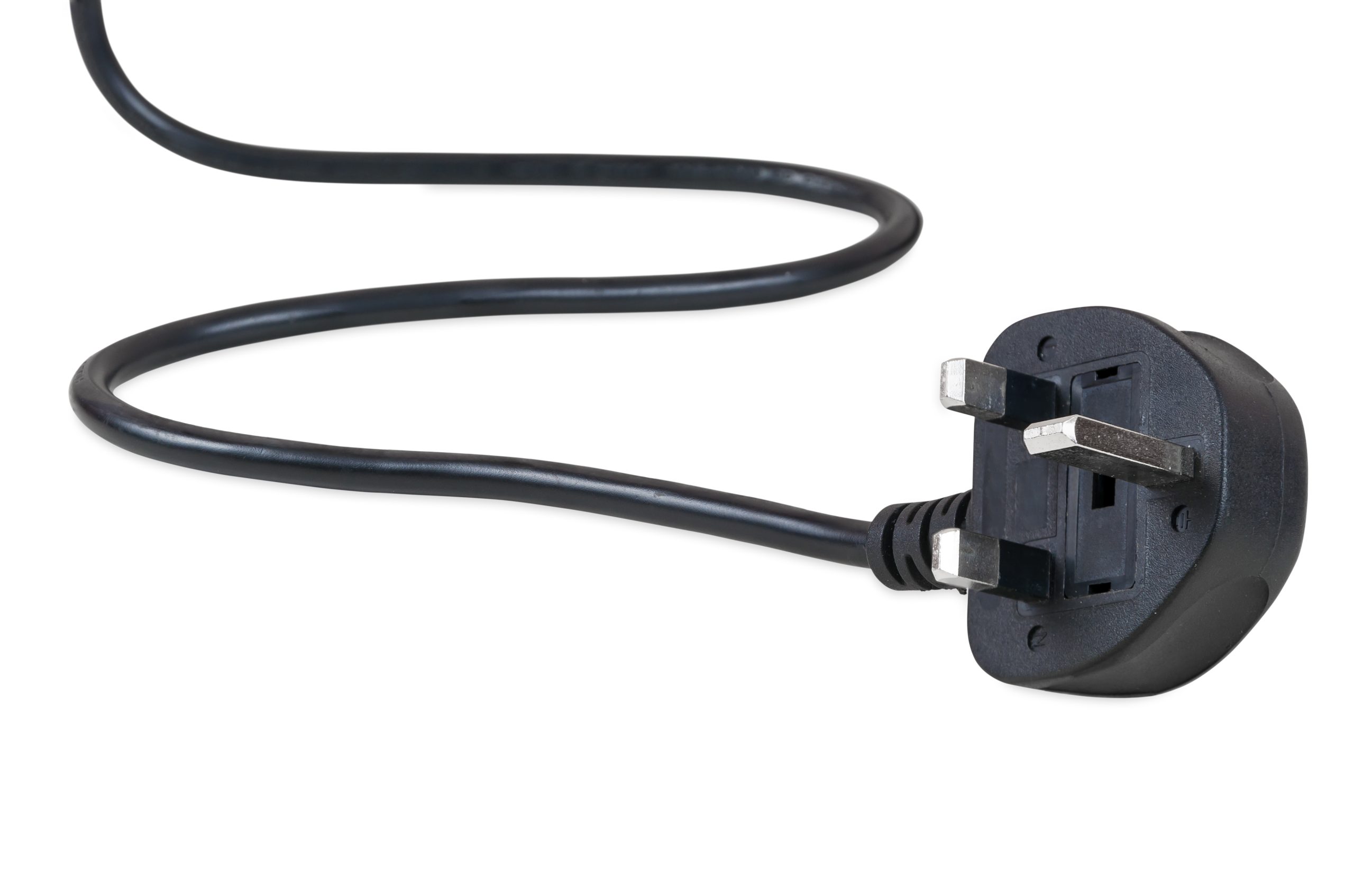
CATA’s full dishwasher range includes both freestanding and integrated models, each supplied with a UK 13A plug. Installation dimensions and electrical specifications are on each product page. If you are also considering the integrated door fitting process, the guide to integrated dishwasher cabinet doors covers door panel sizing and bracket alignment in detail.
Socket guide for common kitchen appliances
| Appliance | Typical draw | Standard socket? | Notes |
|---|---|---|---|
| Dishwasher | 1,200 to 2,400W | Yes | Socket must be accessible; no extension leads |
| Microwave grill combo | 800 to 2,500W | Yes | Confirm total input on rating plate; no extension leads |
| Gas hob ignition | Under 10W | Yes | Socket must not be in the burner zone; fused spur is an option |
| Ceramic hob | 4,000 to 7,000W | No | Dedicated radial circuit with cooker control unit required |
| Induction hob | 3,500 to 7,400W | No | Dedicated radial circuit with cooker control unit required |
| Built-in microwave (high power) | 2,500 to 3,500W+ | Check rating plate | Above 3,000W total input requires a dedicated circuit |
| Fridge or freezer | 100 to 400W | Yes | Should ideally use a dedicated socket on a permanently live circuit |