Vibration Control in Wine Storage: How to Protect Your Collection
Vibration is one of the least visible threats to stored wine, but over months and years it causes measurable damage to wine in maturation. A well-designed wine cooler addresses this through rubber feet, anti-vibration shelving, and low-vibration compressor technology. Understanding which features matter — and how to position your cooler correctly — makes a genuine difference to how your wine ages.
Why Vibration Damages Wine
Wine is a living liquid. It undergoes slow chemical changes as it ages — tannins polymerise, acids evolve, and sediment gradually precipitates out of solution. These processes depend on the molecules involved settling and reacting at a pace set by temperature and time, not by mechanical agitation.
Vibration disrupts this in two ways. First, it keeps sediment particles in suspension rather than allowing them to settle against the bottle. For red wines in particular, this means the tannins and pigments that would otherwise precipitate out remain distributed through the wine, altering its texture and perceived flavour when poured. Second, sustained vibration at certain frequencies accelerates oxidation by disturbing the cork seal and creating micro-agitation at the liquid surface. The effect is subtle over weeks but measurable over years.
The most dangerous vibration sources are not dramatic shocks — the occasional bump when moving a bottle does little harm. The damage comes from low-level, continuous vibration: a wine cooler compressor cycling on and off, a refrigerator next door, a washing machine on a spin cycle nearby, or a wine cooler sitting on uneven or resonant flooring. These low-amplitude, high-frequency vibrations are precisely what a well-designed cooler is built to absorb.
How Wine Coolers Reduce Vibration
A wine cooler that takes vibration control seriously addresses it at multiple points in the system. Each mechanism tackles a different part of the vibration pathway from the compressor to the bottle.
Rubber feet
The rubber or elastomeric feet under a wine cooler are the first line of defence. They prevent vibration from the floor (footsteps, nearby appliances, structural movement) from travelling up into the cabinet. They also absorb the downward impulse of the compressor starting and stopping, preventing it from transmitting through the floor and reflecting back up into the unit. The hardness and profile of the feet affect how well they dampen different frequencies.
Anti-vibration shelving
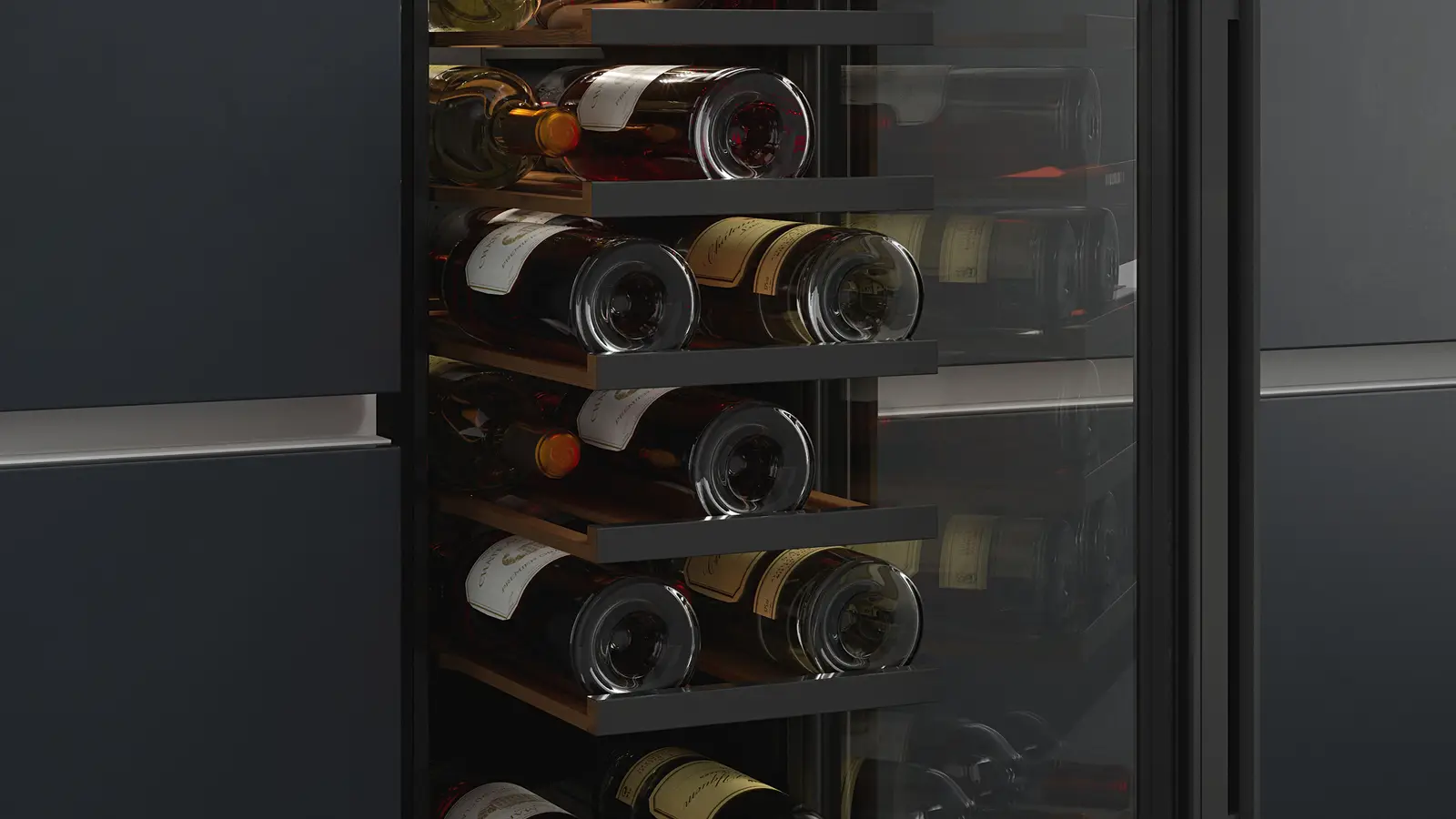
Purpose-designed wine cooler shelves use rubber or silicone mounts at each contact point between the shelf frame and the cabinet wall. This isolates the shelf — and the bottles resting on it — from vibration in the cabinet structure. When the compressor cycles or the door closes, energy is absorbed at the shelf mount rather than transmitted into the wine.
Low-vibration compressors
Modern compressor technology produces significantly less mechanical vibration than older designs. Thermostatic expansion valves and variable-speed compressors run at a steadier rate rather than cycling abruptly on and off, which reduces the amplitude of vibration generated by the cooling system itself. Some premium wine coolers use thermoelectric cooling, which has no compressor at all — though this limits their temperature range.
Cabinet mass and construction
A heavier, more rigid cabinet resists vibration better than a lightweight one. Thick steel panels and solid door construction dampen resonance within the unit. Double-glazed glass doors add both thermal insulation and mass to the door panel, reducing the frequency at which it resonates when the compressor runs. This is one reason why premium wine coolers feel substantially different to handle compared to budget equivalents.
The vibration pathway — and where rubber feet intervene
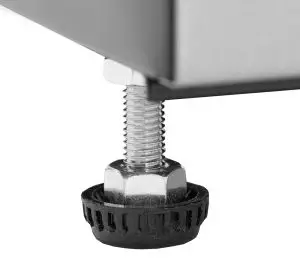
Vibration in a wine cooler travels in two directions simultaneously. The compressor generates movement that travels upward through the cabinet frame toward the shelves and bottles. At the same time, that same movement travels downward through the feet into the floor, reflects, and can travel back up. Rubber feet interrupt this loop by absorbing energy in both directions at the contact point between the appliance and the floor.
The material matters. A very hard rubber foot absorbs high-frequency vibration but allows lower frequencies through. A softer, more compliant foot absorbs a broader frequency range but may compress over time under the weight of a fully loaded cooler, reducing its effectiveness. Well-engineered feet use a durometer (hardness rating) matched to the compressor’s typical vibration frequency — usually in the range of 25 to 50Hz for domestic compressors.
If your wine cooler is placed on hard flooring such as tile or stone, adding a thin anti-vibration mat beneath the unit significantly improves isolation beyond what the built-in feet alone can achieve. Anti-vibration mats made from closed-cell foam or neoprene are inexpensive and can be cut to size.
Relative vibration impact on stored wine by source
Positioning Your Wine Cooler for Minimum Vibration
The best-designed wine cooler in the world is compromised by poor placement. These are the positioning decisions that have the most practical impact on vibration reaching your bottles.
Keep it away from the washing machine
A washing machine on a spin cycle is the single worst neighbour for a wine cooler. It produces intense vibration at a broad frequency range and transmits it through both the floor and any shared wall or cabinetry. Maintain at least one metre of separation if both appliances are in the same room, and never place them in direct contact.
Check the floor is level
A wine cooler sitting at an angle puts uneven load on the feet, compresses some more than others, and can cause the compressor housing to vibrate asymmetrically. Most coolers have adjustable feet for levelling. Use a spirit level and spend two minutes adjusting before loading any bottles.
Avoid suspended timber floors where possible
Suspended timber floors flex slightly under load and transmit foot traffic vibration into everything resting on them. If your wine cooler must go on a suspended floor, an anti-vibration mat under the unit makes a meaningful difference. A stone, concrete, or solid tile floor is inherently better for vibration isolation.
Integrated models benefit from solid cabinet installation
A built-in wine cooler fitted securely into cabinetry has less freedom to rock than a freestanding model that can shift slightly over time. Ensure the unit is properly secured at the fixing points specified in the installation manual, and that it does not vibrate against adjacent cabinet panels when the compressor runs.
CATA’s wine cooler range includes both freestanding and built-in models with low-vibration compressors and anti-vibration shelving as standard. Both the freestanding and built-in ranges are designed with long-term wine storage in mind, not just short-term chilling.
Red vs White Wine: Does Vibration Affect Them Differently?
Both red and white wine are affected by sustained vibration, but the consequences show up differently because of each wine’s composition.
Red wine
More sensitive to vibration over the long term. Reds contain significant quantities of tannins and anthocyanins that precipitate out of solution as sediment during ageing. Vibration keeps this sediment suspended, changing the wine’s texture and the development of its tannin structure. For any red wine aged beyond two to three years, vibration control is particularly important. A wine intended to be decanted before serving is not the concern here — it is the day-to-day movement that cumulatively affects the ageing trajectory.
White and sparkling wine
Less prone to sediment-related issues but still sensitive to vibration at the cork. Sparkling wines are especially vulnerable — CO₂ in solution is affected by agitation, and consistent vibration can accelerate gas escape through micro-movement at the closure. Premium sparkling wines stored for more than a few months benefit from the same vibration isolation as reds. For everyday drinking whites stored for weeks rather than years, the practical impact is minimal.