Home » Wine Cooler Guides & Advice » What’s the Difference Between a Wine Fridge and a Regular Fridge?
What Is the Difference Between a Wine Fridge and a Regular Fridge?
In this guide
Feature by feature: wine fridge vs regular fridge
The differences between the two appliances run deeper than temperature alone. Each one is optimised for a fundamentally different purpose, and those design priorities conflict directly when it comes to wine storage.
| Wine fridge | Regular fridge | |
|---|---|---|
| Temperature range | 5°C to 18°C Ideal for wine | 1°C to 4°C Too cold for wine |
| Temperature stability | Consistent; minimal cycling Good | Fluctuates with door opening and food load Poor for wine |
| Humidity | 50 to 70% maintained Keeps corks sealed | Very low; actively dehumidifies Dries corks out |
| Vibration | Low-vibration design Safe for ageing | Frequent compressor cycling Disturbs sediment |
| UV protection | UV-protected or solid door Protects wine | No UV consideration Indirect light only |
| Bottle orientation | Horizontal racks keep cork moist Correct | Upright shelves designed for food containers Cork dries faster |
| Odour transfer | No food stored; clean environment No risk | Food odours can penetrate corks over time Risk with prolonged storage |
| Temperature zones | Single or dual zone for red and white Flexible | Single fixed zone for food Not adjustable for wine |
| Suitable for long-term storage? | Yes | No. Days only. |
Temperature: the most critical difference
A kitchen fridge runs at 1°C to 4°C because that is the range that slows bacterial growth in food. Wine needs a completely different temperature environment. White wines store best between 7°C and 12°C; light reds between 12°C and 14°C; full-bodied reds between 14°C and 18°C. Storing any of these at fridge temperatures does not simply slow their development: it mutes aromatics, causes tannins in red wines to taste harsh and astringent, and can precipitate tartrates, leaving harmless but unwelcome crystals in the bottle.
The stability of temperature matters as much as the setting itself. Every time a regular fridge door opens, the internal temperature rises several degrees before the compressor cycles back down. Over a day of normal kitchen use, a standard fridge may cycle through a range of 4°C to 8°C repeatedly. These fluctuations cause the wine and the cork to expand and contract. Over weeks and months, this stresses the cork seal and can allow micro amounts of air into the bottle, which accelerates oxidation.
A dedicated wine cooler is engineered to hold a narrower temperature band with fewer cycles. The insulation is typically thicker, the thermostat more precise, and the cooling mechanism chosen for steady maintenance rather than rapid recovery after large temperature swings.
Humidity and cork health
This is the dimension most people overlook, and it is where a regular fridge causes the most irreversible damage to wine stored for more than a few days.
A natural cork is a living material. It needs ambient moisture, ideally 50% to 70% relative humidity, to remain slightly pliable and maintain a tight seal against the neck of the bottle. A regular refrigerator actively removes moisture from the air as part of its food-preservation function. The typical humidity inside a running kitchen fridge is below 40% and often substantially lower.
A cork stored in this dry environment slowly loses moisture. As it dries, it contracts very slightly. That contraction creates a microscopic gap between the cork and the glass, through which oxygen can enter. Oxygen is the primary agent of wine oxidation: it converts ethanol to acetaldehyde, which gives the wine a flat, sherry-like taste entirely different from what the winemaker intended.
This process happens gradually. A bottle stored in a dry environment for two or three days is likely unaffected. A bottle stored for two or three months begins to show signs of early oxidation. A bottle stored for six months or more is at serious risk of being significantly compromised.
Vibration and long-term storage
Wine ageing is a slow series of chemical reactions occurring inside a sealed bottle. Sediment forms as tannins and pigments polymerise over time. This is a normal and desirable process in red wines intended for cellaring, and the sediment that results is harmless but represents the wine at the stage of development its storage conditions allowed.
Vibration disrupts these processes. The compressor in a standard kitchen fridge cycles on and off frequently throughout the day, and each cycle produces vibration that travels through the shelves and into any bottles resting on them. For wine stored for a week, this effect is negligible. For wine stored for months or years, constant low-level agitation interferes with the slow chemical reactions that produce complexity and depth, and can keep sediment suspended in the wine rather than settling cleanly.
Wine coolers, particularly thermoelectric models, are designed to minimise this. Even compressor-based wine coolers run at lower vibration levels than a standard fridge, partly because their thermal mass is more stable and requires fewer compressor cycles to maintain temperature.
Storage design and what goes wrong in a regular fridge
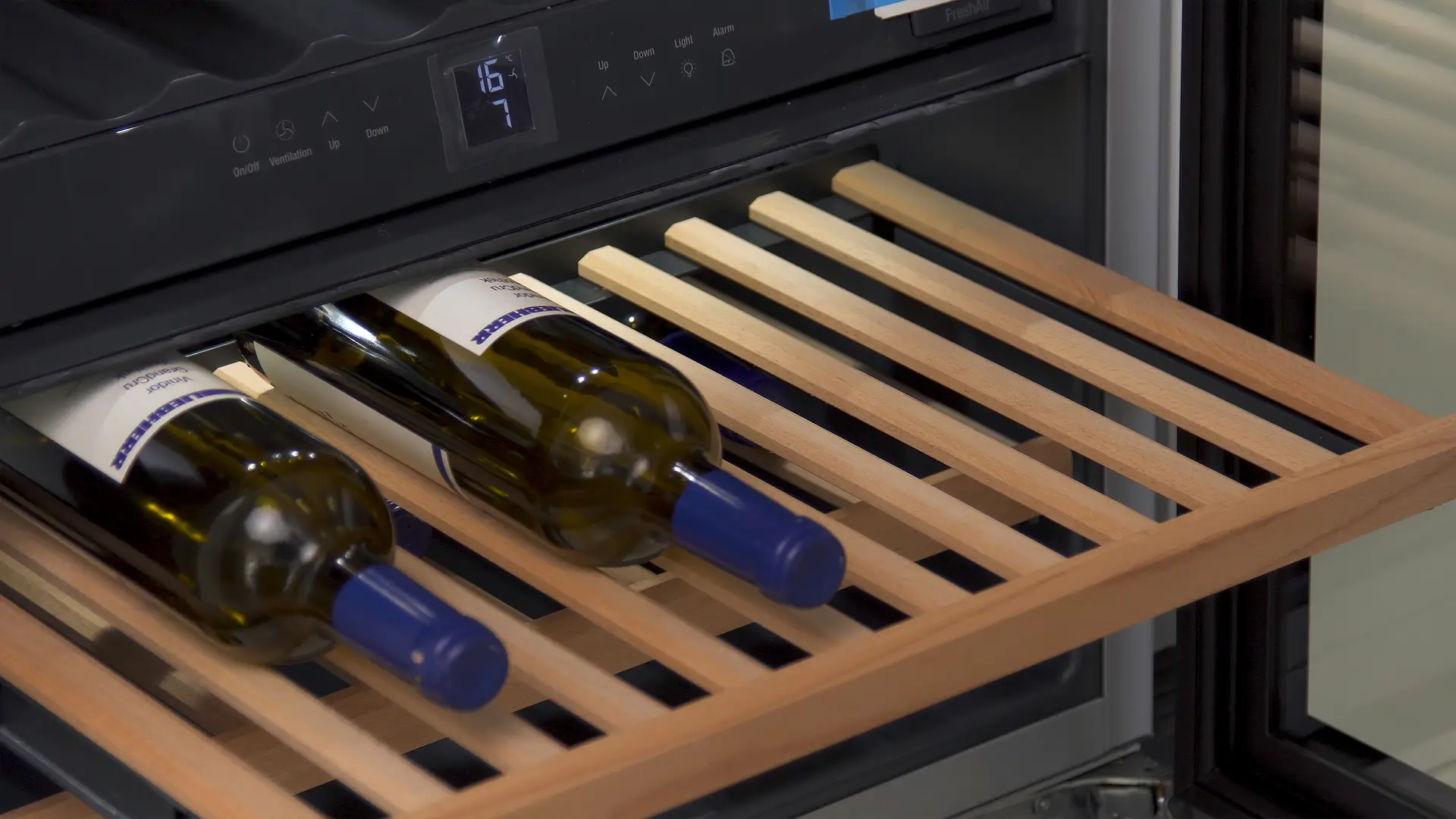
Beyond the mechanical differences, the physical storage environments reflect completely different design priorities. Wine coolers hold bottles horizontally on dedicated racks. A regular fridge holds everything upright on shelves designed for food containers, jars, and drinks cartons. Each of the design differences has a specific consequence for wine stored in the wrong environment.
When is a regular fridge acceptable for wine?
The regular fridge is not always the wrong tool. The problems described above are cumulative and time-dependent. For short-term use, a regular fridge is entirely adequate.
A regular fridge is fine for chilling a bottle of white wine or sparkling wine in the hours before serving. It is fine for keeping an opened bottle of wine fresh overnight or for two to three days, particularly if you use a wine stopper to limit oxidation after opening. It is also fine for a bottle of red wine that you want to bring down slightly in temperature before serving on a warm day.
What it is not suitable for is storage: keeping bottles for weeks or months with the expectation that they will be in the same or better condition when you open them. For that purpose, the temperature is wrong for most wine styles, the humidity is wrong for corks, the vibration is too high for ageing wine, and the presence of food creates risks that simply do not exist in a dedicated wine cooler.
- Do not store red wine in a regular fridge for more than a day or two. The temperature is significantly below its safe storage range and will progressively affect flavour, particularly in full-bodied reds where tannin structure is sensitive to cold.
- Do not use a regular fridge as long-term storage for any wine you care about. Even robust whites will show signs of cork desiccation and premature ageing after a few months in a standard refrigerator environment.
- If you store wine in a regular fridge overnight, lay the bottle on its side. A shelf in the door is the worst position as it exposes the wine to the most temperature fluctuation and the least stable position.
Frequently asked questions
Key takeaways
- A wine fridge holds a steady 5°C to 18°C, maintains 50% to 70% humidity for corks, minimises vibration, and holds bottles horizontally. A regular fridge does none of these things.
- Temperature is the most visible difference: a regular fridge at 1°C to 4°C is far too cold for red wine and at the very low end for white wine storage.
- Humidity is the most damaging difference long term: a regular fridge dries out natural corks, breaking their seal and allowing slow oxidation into the bottle.
- A regular fridge is fine for chilling before serving or keeping an opened bottle for a day or two. It is not suitable for storage beyond that.
- Screw-cap bottles are less sensitive to humidity than cork-sealed bottles, but temperature and vibration concerns still apply.
- For a mixed red and white collection, a dual-zone wine cooler lets you store both types at their ideal temperatures in a single appliance.
Explore More Kitchen Advice & Buying Guides
Browse our latest articles covering appliance tips, energy-saving advice, and expert guidance – designed to help you choose, use, and get the most from your kitchen appliances.