Home » Hob Guides & Advice » Why is only one ring on my hob not working?
Why is only one ring on my hob not working?
A single dead ring while the rest of the hob works perfectly is one of the most common hob faults, and often one of the easiest to solve. Sometimes it is not a fault at all: just a pan, a setting, or the way your hob shares power between zones. This guide helps you find the cause in a couple of minutes and shows you what you can safely fix yourself, and when it is time to call an engineer.
Start here: the free checks
Before assuming anything has broken, spend a minute ruling out the things that cost nothing to fix. A surprising number of dead rings are put right at this stage.
- Swap the pan to another zone. If the same pan fails elsewhere too, the problem is the pan, not the hob. If it works on other zones, the zone itself is the suspect.
- Turn off the other zones and try again. Many induction hobs share power between paired zones, so a ring can go quiet only when its neighbour is running hard. More on this below.
- Check for a lock or a leftover setting. Child lock, control lock, a paused zone, or a residual heat state can all make a zone seem dead. A quick look at the manual confirms the symbols.
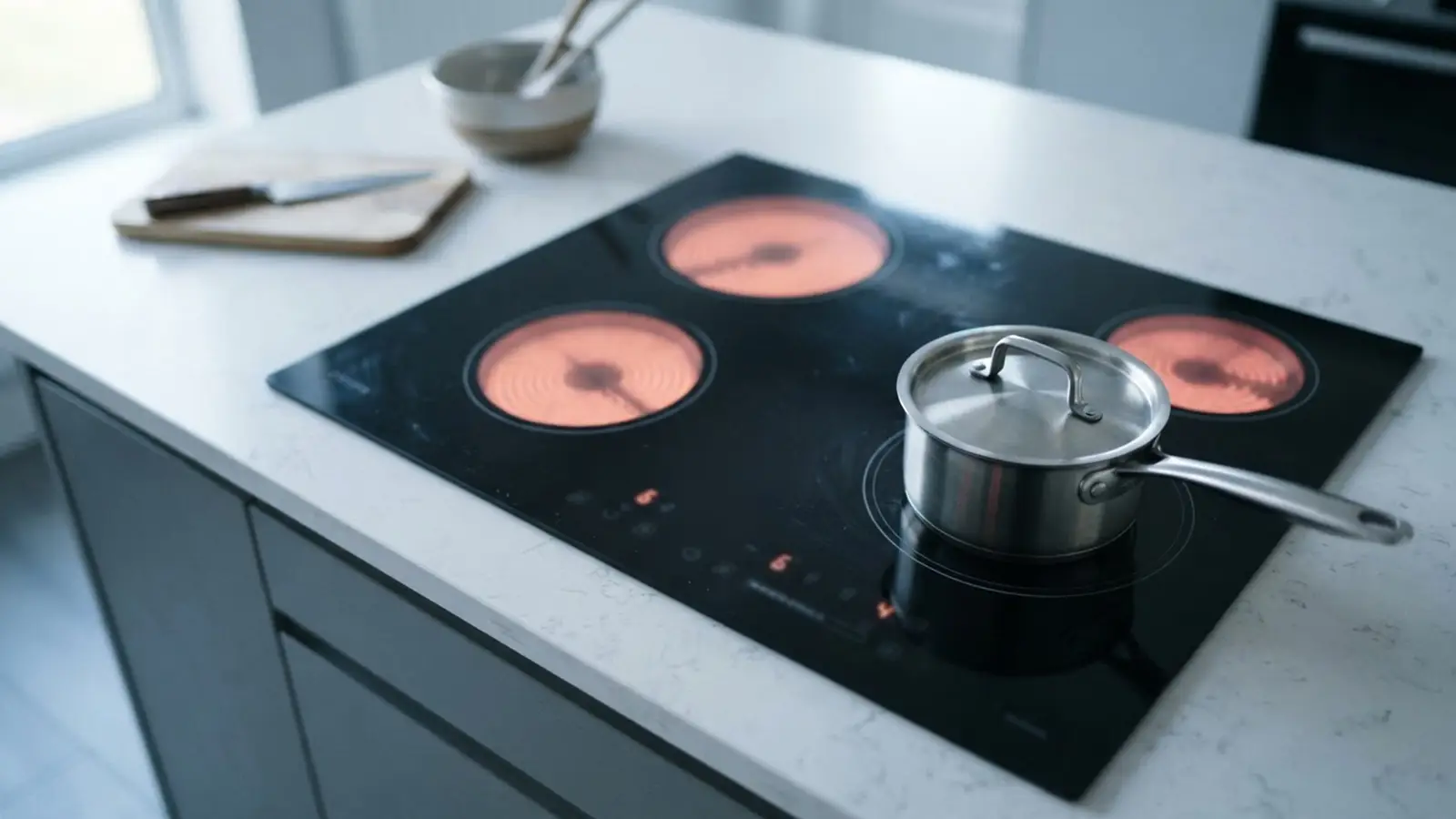
- On a dual zone ceramic ring, switch the outer ring on. The larger ring often needs activating separately, so it stays cold until you do.
- On gas, clean and reseat the burner. Make sure the burner cap is dry, sitting squarely, and that the small flame ports are not clogged with food.
Hob fault finder
Still stuck? Tell the tool what you have and what the zone is doing, and it will point you to the most likely cause and your next step.
Interactive Find the likely cause
Step 1: what type of hob do you have?
Step 2: what is the zone doing?
What it means by hob type
The same symptom points to different parts depending on how your hob makes heat. Here is the quick reference.
Induction most often not a fault
A dead or weak zone is frequently power sharing or a pan that is too small, off centre, or not magnetic. A true fault usually lies in that zone’s coil or power module.
Ceramic usually a part
If the outer ring is switched on and it still will not heat, the radiant element or its control switch has usually failed. Both are replaceable parts.
Gas often cleanable
A burner that will not light or keeps going out is commonly blocked ports, a misseated cap, or the flame safety sensor. Many cases clear with a careful clean.
Solid plate usually a part
A dead or persistently weak plate points to a failed element or its regulator switch. These are engineer replaced components rather than DIY fixes.
For induction, it is always worth confirming the pan itself is suitable. Our guide to the magnet test shows how to check in seconds.
The induction trick worth knowing
Most induction hobs pair their zones, usually the two on the left and the two on the right, so each pair shares a single power module. When you push both zones in a pair to a high setting or Boost at the same time, the hob caps or briefly switches off one of them to stay within that module’s limit.
The result feels like a broken ring, but nothing is wrong. Move your pan to a zone in the other pair, or turn the neighbouring zone down, and full power returns. If you want the detail on how zones and coils work, see how flex zone induction hobs work.
One zone, or a whole side?
This distinction changes everything about the diagnosis, so it is worth a moment.
A single dead zone while its neighbours work almost always means a faulty component for that one zone, such as an element, coil, or switch. It is a contained, replaceable fault.
A whole side or half the hob going dead is a different signal. Hobs are often connected through a wiring block, and sometimes across more than one circuit, so a loss of several zones together points to an electrical supply or connection issue rather than a single part. That is one for a qualified electrician or engineer to check, especially if a breaker keeps tripping.
Before you inspect anything
Isolate an electric hob at the wall or consumer unit before looking at any connections. On gas, only ever clean the burner parts on the surface: never poke the injectors or dismantle gas components. If you smell gas, turn off the supply, avoid switches and flames, open windows, and call the National Gas Emergency line on 0800 111 999.
Fix it yourself, or call an engineer?
Here is the honest split between what is safe to tackle at home and what needs a professional and a genuine spare part.
Safe to do yourself
- Testing pans and swapping zones
- Ruling out locks and settings
- Managing induction power sharing
- Switching on a dual zone outer ring
- Cleaning and reseating gas burners
- Clearing blocked hob vents and letting an induction hob cool
Leave to an engineer
- Failed radiant or solid plate elements
- Induction coils and power modules
- Energy regulators and control switches
- Gas thermocouples and flame safety devices
- Anything involving internal wiring
- Any repeated breaker tripping
If it does turn out to be a part, the good news is that a single component is far cheaper than a new hob. Every CATA appliance comes with a 5 year parts and 2 year labour warranty when you register within 30 days of purchase, backed by a nationwide network of approved engineers.
Frequently asked questions
Many induction hobs pair two zones that share a single power module. When both paired zones run on high or Boost, the hob limits or switches off one to stay within its power budget. Turn the other zone down or move your pan to an unpaired zone.
Not always. If it is caused by a pan, a setting, or power sharing, it costs nothing to fix. If a heating element, coil, or switch has failed, it usually needs a spare part and an engineer, but a single component is far cheaper than replacing the whole hob.
You can safely rule out pans, settings, and power sharing, and clean gas burners yourself. Anything involving the internal wiring, elements, or gas components should be left to a qualified engineer, as these carry electrical and gas safety risks.
This is usually the flame supervision device, a safety sensor that shuts off the gas if it does not detect a flame. It can be blocked by dirt or spills, or the sensor may be failing. Clean around it gently and hold the control in for a few seconds longer. If it keeps happening, it needs an engineer.
A ceramic zone that heats weakly often has a failing radiant element, or the outer ring of a dual zone area has not been switched on. Check the dual zone control first, and if a single zone is still weak, the element is likely on its way out.
Yes. A single dead zone is usually a faulty component for that zone. A whole side going out points to an electrical supply or connection issue, which an electrician or engineer should check rather than treating it as a single part.
Key points
- Test the pan on another zone first to learn whether the pan or the zone is at fault.
- On induction, a quiet zone is often power sharing, not a fault, so turn the neighbouring zone down.
- Rule out locks, settings, and a dual zone outer ring before assuming anything has broken.
- One dead zone usually means a single faulty part. A whole side out points to an electrical issue.
- Pans, settings, and gas burner cleaning are safe to do yourself. Elements, coils, switches, and wiring are engineer jobs.
Need a part or an engineer?
Find manuals, order genuine spares, and reach an approved CATA engineer through product support.
Visit product supportExplore More Kitchen Advice & Buying Guides
Browse our latest articles covering appliance tips, energy-saving advice, and expert guidance – designed to help you choose, use, and get the most from your kitchen appliances.