Home » Cooker Hood Guides & Advice » Can a Cooker Hood Be Noiseless? Quiet Kitchen Extraction Explained
Can a Cooker Hood Be Noiseless? Quiet Kitchen Extraction Explained
No cooker hood is completely silent — moving air through a fan and duct inevitably produces sound. But the gap between the noisiest and quietest models is substantial. A premium quiet hood on its lowest speed can measure below 40 dB, which is quieter than a library. Understanding what makes hoods noisy, and what to look for when choosing, makes the difference between a hood you barely notice and one that dominates the kitchen conversation.
What Cooker Hood Noise Levels Actually Mean
Cooker hood noise is measured in decibels (dB) at a standard distance, typically at the minimum and maximum fan speeds. The decibel scale is logarithmic — a 10 dB increase represents roughly double the perceived loudness. This means the difference between a 55 dB hood and a 65 dB hood is far more noticeable than the numbers suggest.
Noise level reference — cooker hoods and comparison sounds
When comparing products, always look at the dB rating at the speed you actually plan to use. Most everyday cooking requires no more than medium speed — the maximum speed figures that appear in some specifications are for brief, heavy cooking situations and are not representative of typical use. A hood rated at 65 dB maximum but 42 dB at minimum is genuinely usable at low speed in an open-plan room.
Where the Noise Comes From
Cooker hood noise has four distinct sources, each with different characteristics and different solutions. A hood that sounds loud may be noisy at just one of these points — identifying the source is the first step to addressing it.
Fan motor noise
The dominant noise source on most hoods. The motor drives an impeller or centrifugal fan at high rotational speed, producing a combination of mechanical hum from the motor itself and aerodynamic noise from the blades moving through air. Higher-quality motors with precision bearings and balanced impellers run significantly more quietly at equivalent airflow. Brushless DC motors — increasingly common on premium hoods — produce noticeably less mechanical noise than conventional AC motors.
Air turbulence at the grease filter
Air being drawn through the grease filter mesh produces turbulence noise — a rushing or whooshing sound that increases with fan speed and extraction rate. Filters with larger surface area (spreading the airflow over a wider mesh) produce less turbulence per unit of airflow. Baffled filters, which use angled channels rather than flat mesh, also tend to produce less turbulence noise at equivalent extraction rates. A clogged filter increases this noise considerably — a grease-saturated filter forces air through a smaller effective aperture.
Ductwork transmission and turbulence
Air rushing through the duct from the hood to the external vent produces its own noise, which is often transmitted back into the kitchen through the hood housing and cabinetry. Sharp bends in the duct run create turbulence that adds to the total noise level. Undersized ducting — a 100mm duct on a hood rated for 150mm — forces air through at higher velocity, increasing both duct noise and the motor’s workload. Rigid circular duct produces less turbulence than flexible corrugated duct at equivalent air velocity.
Vibration transmitted to cabinetry
Even a quiet motor produces vibration at its mounting frequency. If this vibration is transmitted to the hood housing, adjacent cabinets, or the duct run, it can produce a disproportionately audible rattle or hum that bears little relation to the measured dB figure. Anti-vibration mounting brackets between the motor and housing reduce this significantly. Loose internal components — grease filter clips, lighting covers — rattle at certain fan speeds and can be mistaken for a motor fault.
What to Look for When Buying a Quiet Hood
The headline noise figure in product specifications is a starting point, not the whole picture. These are the specific features that make a measurable difference to how quiet a hood is in everyday use.
dB rating at low and medium speed
The minimum speed dB figure is the most relevant for everyday cooking. A hood with 40 dB at minimum and 65 dB at maximum is an excellent everyday appliance — the maximum speed is for brief, heavy cooking. Ask for the multi-speed dB figures rather than relying on a single quoted number.
Extraction rate relative to kitchen volume
A hood that is correctly sized for the kitchen’s volume runs at lower speed for everyday cooking, producing less noise. An undersized hood must work at higher speed to clear the same cooking output, generating more noise. As a rule, the hood should be capable of cycling the kitchen’s air volume at least ten times per hour — size up rather than down.
Baffle rather than mesh filters
Baffle filters (pressed metal channels) produce less turbulence noise than aluminium mesh at equivalent extraction rates, because the wider channel geometry allows air to flow with less restriction. They are also more effective at grease capture and easier to clean. Most premium and mid-range hoods now use baffle filters as standard.
Integrated or remote motor option
Some premium installations position the main fan motor remotely — in the roof void or outside the building — so only the duct and the control panel are in the kitchen. This removes the primary noise source from the living space almost entirely. The trade-off is installation complexity and cost. For open-plan spaces where noise is a primary concern, remote motors produce results no in-unit motor can match.
Variable speed control
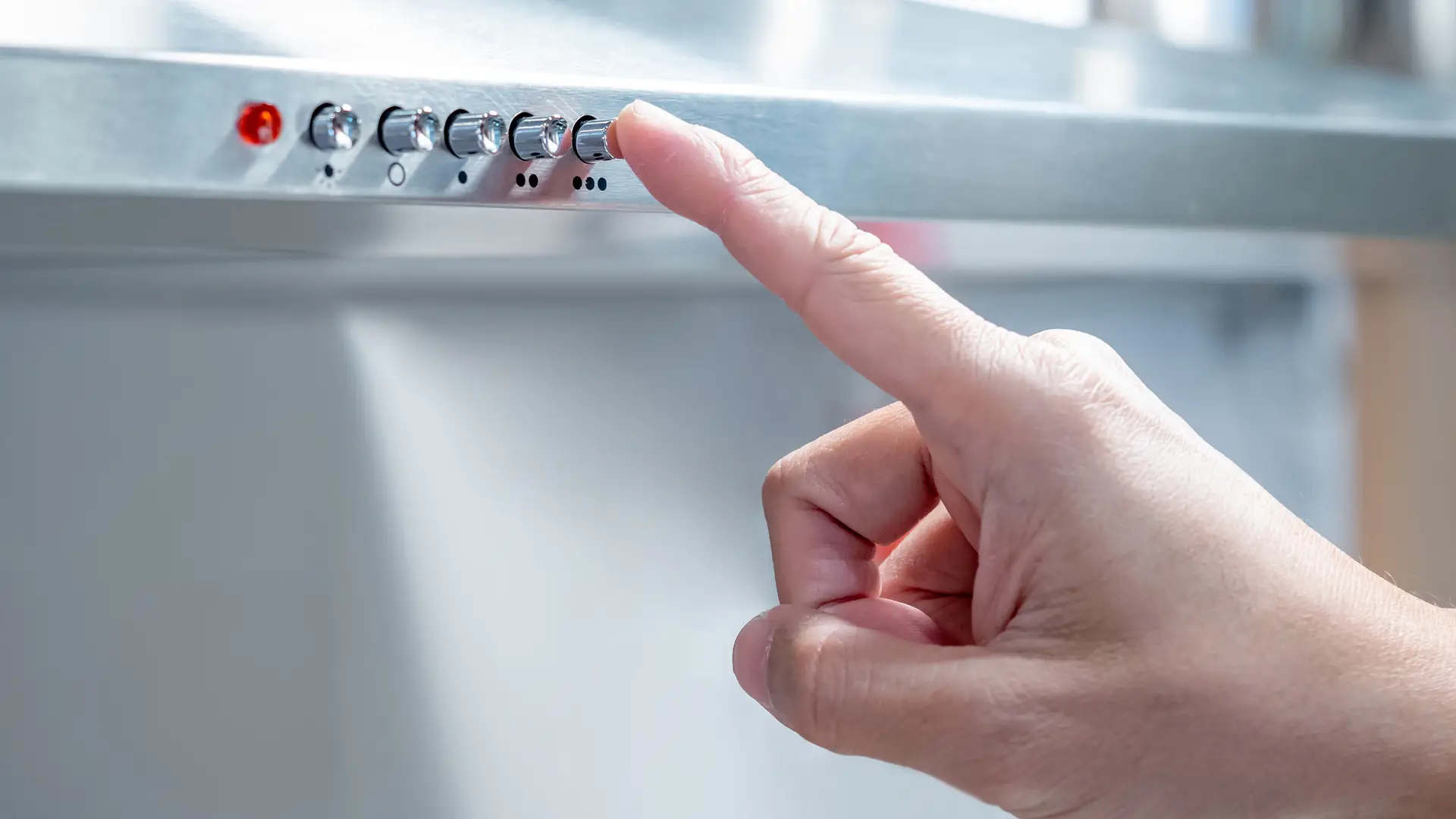
A hood with many discrete speed steps (or continuously variable speed) allows fine adjustment to the minimum needed for the current cooking task. A hood with only two or three speeds forces you to run it faster than necessary for light cooking. More steps means more opportunity to find a quiet effective setting for everyday use.
Hood width relative to hob width
A hood wider than the hob captures cooking vapour more efficiently, capturing the same volume of steam and grease with less airflow — and therefore lower fan speed. A 90cm hood above a 60cm hob produces noticeably less noise for equivalent extraction effectiveness than a 60cm hood in the same position.
Installation Factors That Affect Noise
A quiet hood installed with poor ducting can be as noisy as a budget model with a clean installation. These installation decisions have a direct and significant effect on the noise level in use.
Use the correct duct diameter
Match the duct diameter to the hood’s outlet size. Using a reducer to fit a 150mm-outlet hood into a 100mm duct forces air through at higher velocity, generating turbulence noise in the duct and increasing the motor’s load. Always use the largest practical duct diameter the hood manufacturer specifies.
Keep the duct run short and straight
Every bend in the duct adds resistance, which the motor compensates for by running faster — increasing noise. A long, convoluted duct run to an external vent can double the effective noise output compared to a short, straight run. Where bends are unavoidable, use 90° swept bends rather than sharp elbows.
Use rigid duct rather than flexible
Corrugated flexible duct creates turbulence at every corrugation ridge as air passes through it. Smooth rigid circular duct (aluminium or PVC) produces significantly less duct noise at equivalent airflow. Use flexible duct only for short connection sections where rigid duct cannot be fitted.
Fit an anti-backdraught shutter
A backdraught shutter at the external vent prevents wind noise from entering the duct when the hood is switched off. Some hoods include an internal shutter; others rely on the external vent cover. Both should close fully at rest and open freely when the fan runs. A shutter that only partially closes causes a whistling noise in windy conditions.
Check and tighten all fixings after installation
Loose screws, unsecured duct connections, or a hood not firmly mounted to the wall all create vibration paths that amplify noise. Run the hood at medium speed and run your hand along the duct connections, the hood housing, and adjacent cabinetry to feel for vibration — any that is detectable should be traced and isolated.
CATA’s cooker hood range includes models specified for quiet extraction, with dB ratings at each speed available on individual product pages. For open-plan kitchens where noise is a priority, the integrated hood range conceals the motor unit inside cabinetry, reducing transmitted noise to the kitchen space. The guide to cooker hood grease filter maintenance covers how a clean filter directly affects both noise and extraction performance.
Common questions answered
What is a good noise level for a cooker hood?
Below 45 dB at minimum speed is considered very quiet and suitable for open-plan kitchens where the hood runs during conversation or with the TV on. Below 55 dB at medium speed is good for most enclosed kitchens. Any hood consistently above 65 dB at the speed you use regularly will be noticeable and potentially irritating over a full cooking session.
Why has my cooker hood become louder recently?
The most common cause is a clogged grease filter forcing air through a reduced aperture. Clean or replace the filter first. If the noise persists, check for a loose internal component (filter clip, light cover) that may have worked free. A grinding or rattling sound that has appeared gradually often indicates worn motor bearings — this requires professional attention.
Is a recirculating hood quieter than a ducted one?
Not necessarily at source — the fan motor and airflow noise are similar. But recirculating hoods eliminate duct noise entirely, since there is no duct run to the exterior. In installations where poor ducting is the main noise contributor, a recirculating model can be perceptibly quieter in the kitchen. The trade-off is that recirculating hoods require regular charcoal filter replacement and are generally less effective at removing steam and odours.
Does mounting height affect noise?
Indirectly. A hood mounted at the correct height above the hob captures cooking vapour efficiently at lower fan speeds, so it spends more time running quietly. A hood mounted too high must run at higher speed to maintain effective extraction, generating more noise. Standard recommended mounting height is 65 to 75cm above an electric hob and 70 to 80cm above a gas hob — check the manufacturer’s specification for your model.
Explore More Kitchen Advice & Buying Guides
Browse our latest articles covering appliance tips, energy-saving advice, and expert guidance – designed to help you choose, use, and get the most from your kitchen appliances.