Home » Cooker Hood Guides & Advice » Can Cooker Hoods Remove Steam from Boiling?
Can Cooker Hoods Remove Steam from Boiling?
Yes, but the answer is more specific than it first appears. A ducted cooker hood removes steam from the kitchen entirely by venting air to the outside. A recirculating cooker hood does not remove steam at all: it passes the air through grease and carbon filters and returns it to the room. The filters trap grease particles and reduce cooking odours, but water vapour molecules are too small to be captured by carbon filtration and pass straight back into the kitchen.
Ducted vs recirculating: the steam difference
Ducted extraction
Air drawn into the hood is ducted to an external vent, taking moisture with it. Steam generated by boiling, steaming, and simmering is removed from the building. The kitchen’s moisture level during cooking stays manageable even without opening windows.
The only limitation is extraction rate relative to the volume of steam produced. A large pot of vigorously boiling pasta in a small kitchen on a low fan speed will overwhelm any hood. Use a higher speed or fit a lid.
Recirculating
Air passes through grease filters and activated carbon filters before returning to the kitchen. Grease droplets are captured in the metal filters. Odour compounds are partially absorbed by the carbon. Water vapour is not affected by either filter type.
In practical terms, a recirculating hood reduces cooking smells noticeably but has no effect on steam, condensation, or kitchen humidity. In an airtight modern home, steam from heavy cooking will condense on windows and cold surfaces regardless of how the recirculating hood is running.
Why steam in the kitchen matters
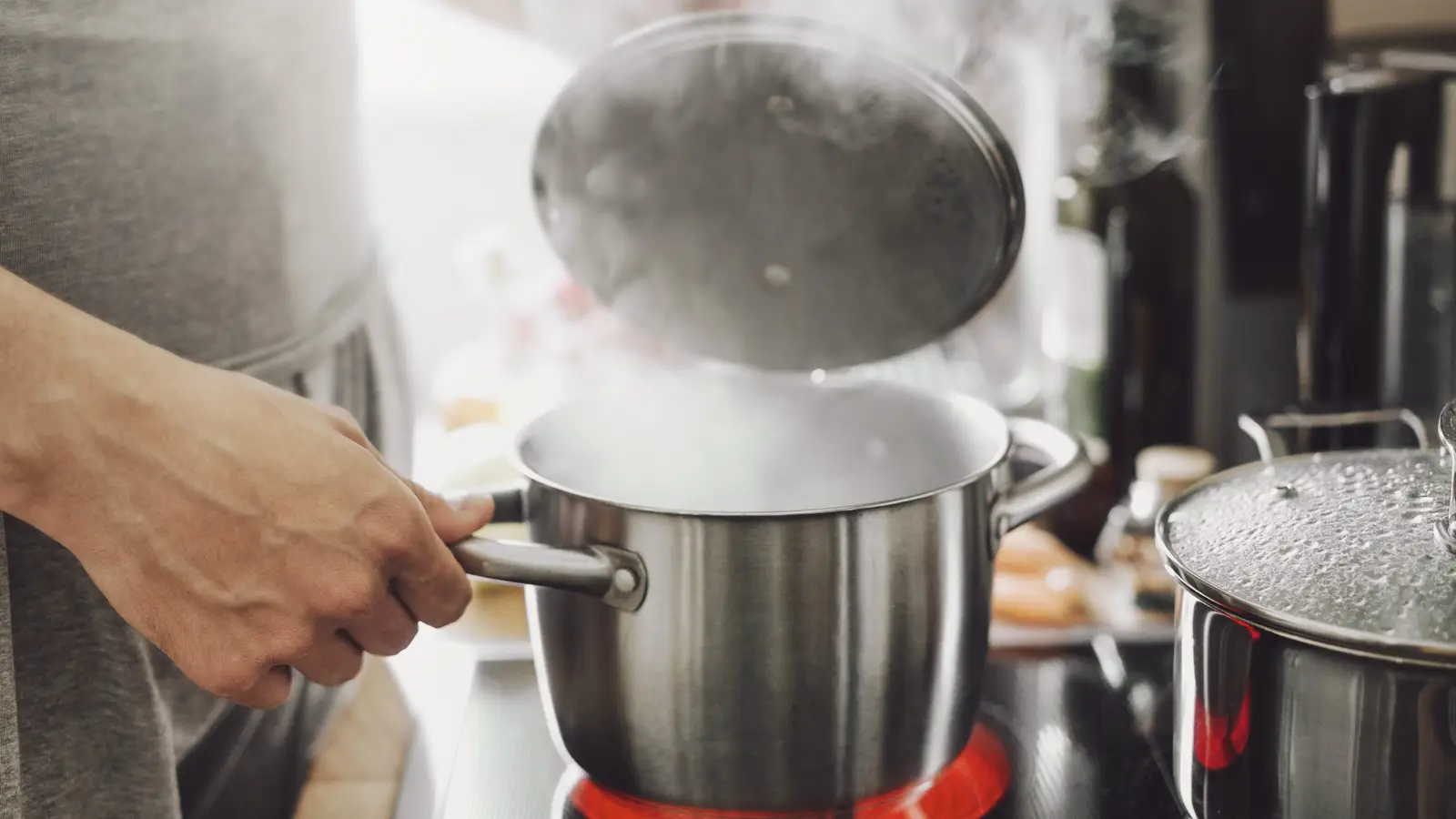
Steam from cooking is water vapour that cools and condenses when it contacts surfaces cooler than the dew point. In a kitchen, this means condensation on windows, cold wall tiles, the backs of cabinets, and any unheated surface adjacent to the cooking area. Repeated condensation in the same places creates the conditions for mould growth, particularly on grout lines, sealant, and the underside of wall cabinets above the hob.
In older draughty houses this is less of an issue because the building fabric breathes and moisture dissipates. In well-insulated modern homes, where air leakage is deliberately minimised, steam from cooking without adequate extraction can raise indoor humidity substantially during a cooking session. A ducted hood is one of the most effective interventions available.
Turn the hood on before boiling starts rather than once steam is already visible. A running hood creates an airflow that draws the rising plume toward the intake before it has dispersed into the room. Starting late means the steam is already spreading by the time the hood is extracting.
What affects how well a ducted hood removes steam
Extraction rate: rated in m³/h, this determines how quickly the hood can cycle the air in the kitchen. For steam removal from heavy boiling in a standard kitchen, 300 to 500 m³/h is typically adequate. See the hood sizing guide for the calculation method.
Installation height: too high and the steam plume disperses before reaching the intake. Too low and it is uncomfortable to cook beneath. The manufacturer’s minimum installation height is set for both safety and capture efficiency.
Filter condition: blocked grease filters restrict airflow and reduce effective extraction rate. Metal baffle filters should be cleaned monthly in heavy use kitchens; mesh filters more frequently. A visibly greasy filter is reducing the hood’s extraction capacity.
Fan speed: running the hood on a low setting during heavy boiling is one of the most common reasons steam is not effectively removed. Match the fan speed to the cooking intensity rather than leaving it on the same setting throughout.
For guidance on ventilation requirements and choosing between ducted and recirculating configurations, see the induction hob ventilation guide and the make-up air guide for airtight homes. For sizing guidance, see what size cooker hood do I need. Browse the CATA cooker hood range.
Explore More Kitchen Advice & Buying Guides
Browse our latest articles covering appliance tips, energy-saving advice, and expert guidance – designed to help you choose, use, and get the most from your kitchen appliances.