The Future of Kitchen Ventilation: Are Vented Induction Hobs Here to Stay?
Yes — and with good reason. Vented induction hobs solve a problem that has frustrated kitchen designers for decades: how to ventilate a cooking surface effectively without a hood dominating the room. By integrating the extraction directly into the hob, they free up the space above the cooktop entirely, enable island layouts that were previously impractical, and simplify the kitchen in ways that pure aesthetics cannot achieve alone.
How Vented Induction Hobs Work
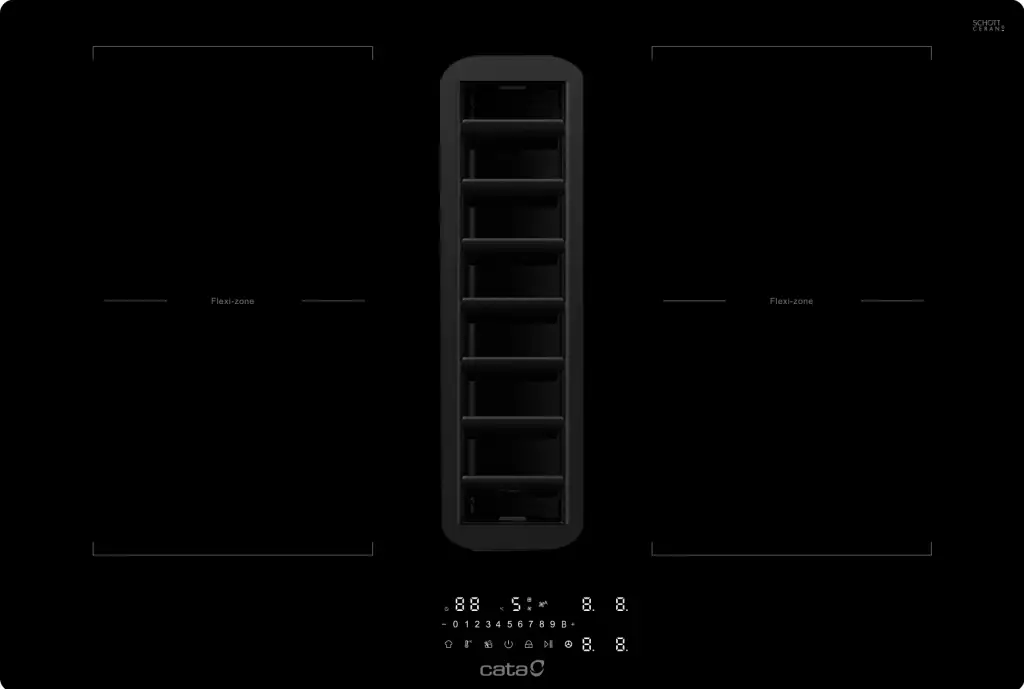
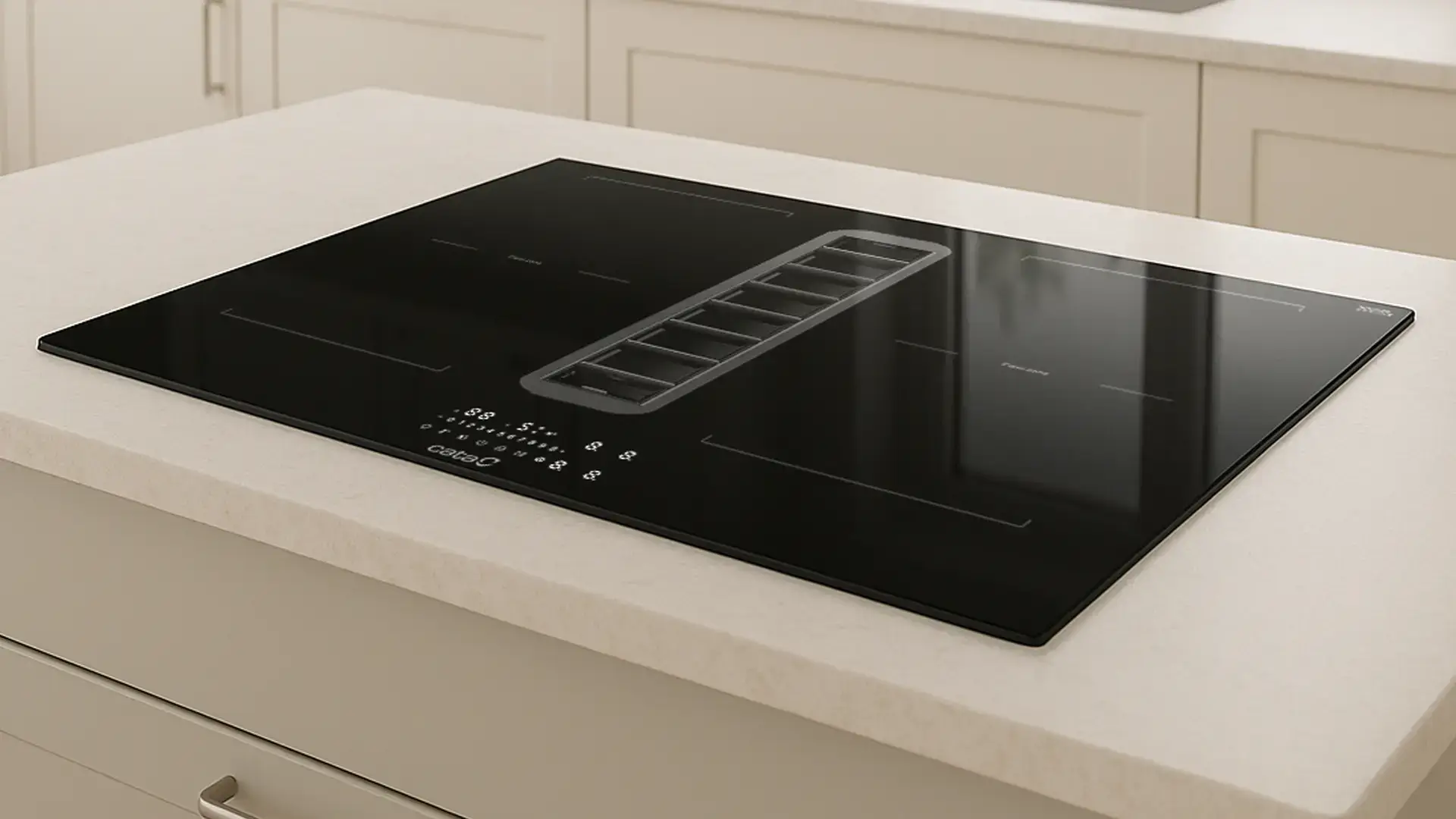
A vented induction hob combines an induction cooking surface with a built-in extraction system, typically housed in a channel running across or around the hob. As steam, grease particles, and cooking odours rise from the pan, a powerful fan draws them downward through the hob — against their natural tendency to rise — and channels them either outside via a duct routed beneath the worktop, or through a filtration system that cleans the air before returning it to the room.
The extraction motor and filtration components sit below the worktop in the void beneath the hob. This is what enables the clean surface-level profile with no hardware above the cooking zone. The fan speed is typically adjustable independently of the cooking zones, though higher-specification models link extraction intensity to the power level being used — automatically increasing airflow when Boost mode is activated and reducing it when zones are switched to low.
There are two installation modes. Ducted systems are more effective — they channel air outside the building, removing moisture, grease, and odour from the kitchen entirely. Recirculating systems pass the air through grease filters and activated charcoal, removing particles and odour before returning clean air to the room. Ducted is always preferable where the installation permits; recirculating works well where external venting is not possible.
Why the Timing Is Right
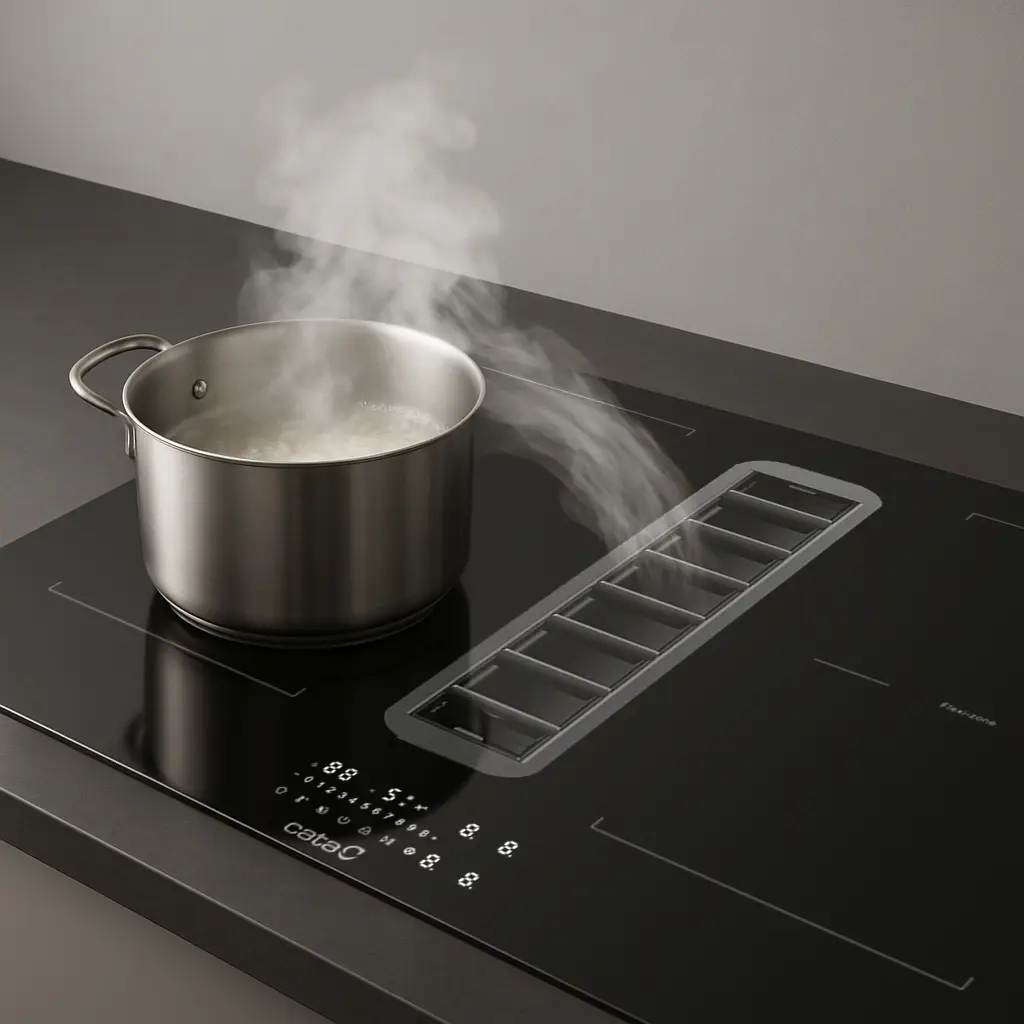
Vented induction hobs are not new — early downdraft hob concepts have existed since the 1980s — but the technology has only reached the performance level required for mainstream domestic kitchens in the last decade. Two things changed: induction hobs themselves became genuinely better (faster, more efficient, with better pan detection), and extraction motor technology improved enough to pull steam downward reliably without the impractically high noise levels that made early downdraft systems unpopular.
The timing also aligns with shifts in how people live in and design their homes. Open-plan kitchen-living spaces have become the dominant preference for new builds and renovations across the UK. In these layouts, a traditional wall-mounted chimney hood is often either architecturally impossible — because there is no wall to mount it on, or the ceiling is vaulted — or visually incompatible with the design language of an open living space. An island hob with a ceiling-mounted extraction arm above it is one solution, but it draws the eye and requires significant structural work. A vented hob in the island surface solves the same problem with no overhead hardware at all.
The move away from gas is a further tailwind. As UK households transition from gas hobs to electric, induction is the logical destination for anyone who cooks frequently — and when choosing an induction hob, the incremental cost of a vented model becomes easier to justify against the alternative of specifying a separate hood as well.
Advantages and Genuine Trade-offs
What works well
Island and peninsula installations. This is where vented induction is genuinely unmatched. No ceiling arm, no structural penetration above the island, no visual interruption between the kitchen and the living space beyond it.
Extraction at source. Capturing steam and grease as they leave the pan, rather than after they have risen a metre to a wall hood, is more efficient. The air in the kitchen stays cleaner during cooking.
Simplified kitchen design. Removing the hood from the specification list frees up both design budget and visual space. The kitchen reads cleaner — no canopy breaking the sightline between the worktop and the ceiling.
Improved air quality in open-plan spaces. Cooking odours that would drift into a living or dining area from a standard hob are captured immediately at the source rather than rising and dispersing.
The genuine trade-offs
Upfront cost. A full-specification vented induction hob costs more than a comparable standard induction hob. Whether this represents good value depends on whether you compare it against the hob-only price or against the combined cost of hob plus a quality cooker hood, which often narrows the gap considerably.
Installation complexity. Ducted systems require a duct run beneath the worktop and through the cabinet void to an external vent — this needs planning before worktops are installed. Retrofitting is possible but more disruptive.
Filter maintenance. Grease filters need cleaning every few weeks in regular use. Charcoal filters in recirculating installations need replacing every six to twelve months. This is comparable to maintaining a standard hood but worth factoring into the ownership cost.
High-intensity cooking. Heavy wok cooking, sustained high-heat frying, or cooking for large numbers simultaneously can challenge the extraction capacity of some models in recirculating mode. Ducted systems handle intensive cooking more reliably.
The Alternatives Compared
Vented induction hobs are one solution to kitchen ventilation. These are the main alternatives and where each one fits best.
The most common solution. Works best directly above a hob positioned against a wall. Effective, available in a wide range of specifications and price points, and straightforward to install. Not suitable for island layouts without a wall nearby, and always visible above the cooking area.
Hangs from the ceiling above an island hob. Effective extraction and can be a design statement in high-ceiling spaces. Requires structural mounting points in the ceiling, a duct run to the exterior through the ceiling void, and significant planning. Not suitable for low ceilings or open-plan spaces where it dominates the room.
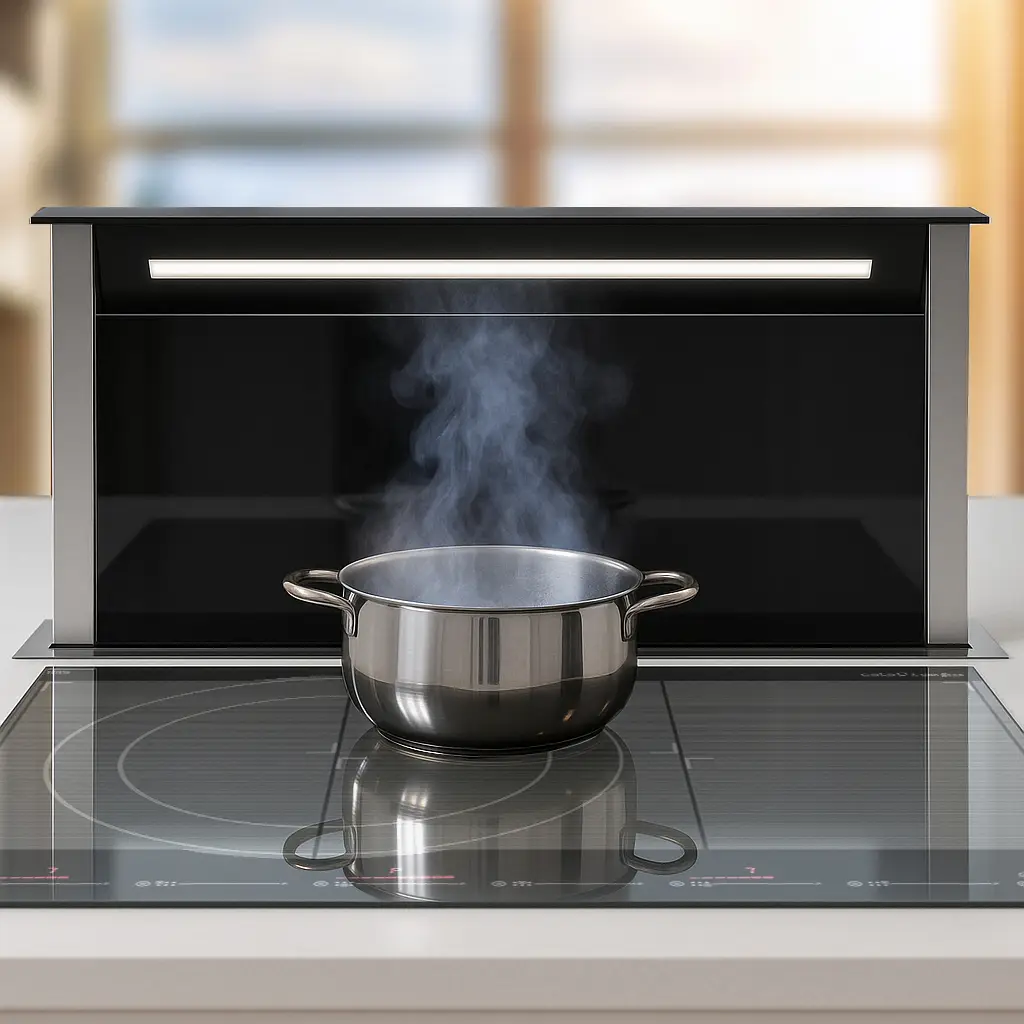
A retractable extraction panel that rises from the worktop behind the hob when in use and lowers flush when not cooking. Effective when positioned correctly relative to the hob and cooking zones. Works alongside any hob type. Does not integrate with the hob controls and takes up worktop depth behind the cooking zone.
A low-profile extraction unit flush-mounted in the ceiling above the cooking area, with a duct run through the ceiling void. Largely invisible and suits minimal design aesthetics. Requires ceiling access for installation and is less effective than a surface-level solution at capturing steam from pans at worktop height.
The Verdict
Are vented induction hobs here to stay?
Yes — and the category will grow. The combination of better motor technology, improved noise levels, and the structural shift in how UK kitchens are designed means vented induction hobs address a real and growing need rather than a niche preference.
For island kitchens, they are already the most practical solution available. For open-plan layouts where a hood would intrude visually, they are a compelling alternative to ceiling extraction. For anyone transitioning from gas who is specifying a kitchen from scratch, the incremental cost over a standard induction hob and a quality hood is modest against the design and practical benefits.
The limitations — filter maintenance, installation planning, cost premium over a basic hob — are real but manageable. The technology is no longer experimental. It has matured into a product category with broad manufacturer support, improving specification at each price tier, and growing consumer familiarity. Vented induction hobs are not a passing trend. They are a logical response to how modern kitchens work and what modern households want from them.
CATA’s vented induction hob range covers ducted and recirculating models across 77cm and 83cm formats. For a detailed technical breakdown of how the extraction system works, see how vented induction hobs work. For a comparison across all hob types, the hob buying guide covers every option in the CATA range.
Common questions answered
Do vented hobs extract as effectively as a wall-mounted hood?
In ducted mode, yes — often more effectively, because they capture steam and grease at source before it rises and disperses. In recirculating mode, they are broadly comparable to a recirculating hood of equivalent specification, with the practical advantage of eliminating the overhead unit. The extraction rate in m³/h is the key comparison figure.
How much space do I need below the worktop for installation?
Most vented induction hobs require 10 to 30cm of clearance below the worktop for the motor, filtration unit, and duct connection. The exact requirement is specified in the installation guide for each model. Some designs allow shallow drawers alongside the unit; others require a clear void. This needs to be confirmed before worktops and cabinetry are ordered.
Can I use a vented hob in a flat where I cannot duct externally?
Yes — recirculating mode works without an external duct connection. Air passes through grease and charcoal filters and returns to the room. The charcoal filter needs replacing every six to twelve months. Extraction effectiveness in recirculating mode is good for everyday cooking but less effective for very high-intensity or high-volume cooking than a ducted installation.
How loud are vented induction hobs at full extraction?
Noise levels have improved significantly over early models. Current full-specification models typically measure 60 to 68 dB at maximum extraction speed — comparable to a mid-range wall-mounted hood at the same setting. At low and medium extraction speeds the noise level is considerably lower and does not typically intrude on conversation in an open-plan space.