Home » Cooker Hood Guides & Advice » Is it Worth Investing in a Downdraft Cooker Hood?
Is It Worth Investing in a Downdraft Cooker Hood?
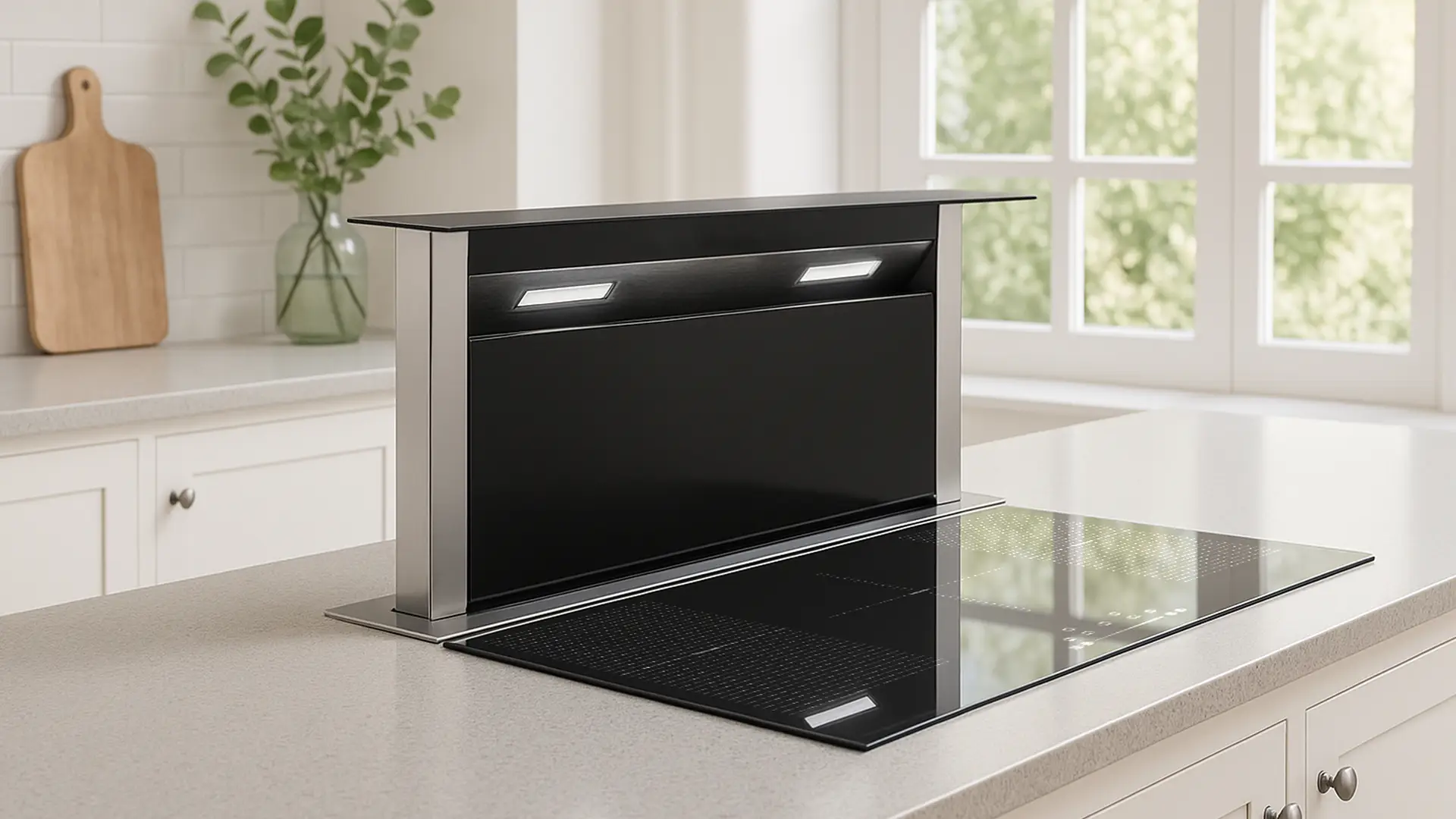
A standalone downdraft extractor is a separate appliance that sits behind or beside the hob, rising from the worktop when needed and retracting flush when not in use. It solves a specific problem: extracting cooking vapour in a kitchen where a ceiling or wall-mounted hood is either impossible or unwanted. Whether it is worth the investment depends almost entirely on the installation situation and what alternatives are available.
How a standalone downdraft extractor works
When activated, a motorised panel rises 30 to 50cm above the worktop level, positioning the intake grille adjacent to the cooking zones. The fan draws steam, grease, and odours horizontally across the hob surface and down through the unit, ducting them either to an external vent through the worktop and cabinet below, or through a recirculation filter block. When switched off, the panel lowers flush with the worktop or the rear of the hob, disappearing completely.
This is architecturally different from a vented induction hob, where extraction is integrated into the hob itself. A standalone downdraft unit can be paired with any hob type (gas, ceramic, or induction), whereas a vented hob is an induction hob with the extractor built in.
How it compares to the alternatives
| Option | Best for | Key limitation |
|---|---|---|
| Standalone downdraft extractor | Existing island or peninsula hob where hob replacement is not planned | Higher cost, more complex installation than a ceiling hood; extraction physics work against rising plume |
| Vented induction hob | New installation or planned hob replacement on an island | Only available in induction; more expensive than a standard hob |
| Ceiling island hood | Any island hob where ceiling height and structure allow ducting | Requires structural ceiling duct route; visually dominant |
| Wall chimney or angled hood | Wall-mounted hob with adjacent wall | Not practical for island or peninsula positions without a nearby wall |
The extraction physics to understand
Steam and cooking vapour rise. An overhead hood captures the plume naturally as it ascends toward the fan. A downdraft extractor works against this. It must pull the rising plume downward or sideways before it can escape into the room. This requires higher fan speeds to achieve comparable capture efficiency, which means more noise and more energy at equivalent extraction rates. A downdraft extractor positioned close to the cooking zones mitigates this significantly, but physics cannot be fully overcome.
In practice, for everyday hob cooking at moderate heat, a quality downdraft extractor captures effectively. For very high heat cooking with large woks or multiple simultaneous high-temperature zones, an overhead solution will outperform a downdraft unit at equivalent price points.
Installation requirements
A standalone downdraft unit requires a duct route through the worktop and cabinet below to an external wall or down through the floor. The motor sits in the cabinet beneath the worktop, which means losing that storage space. For ducted installation, the duct route must be planned before fitting the worktop and cabinetry. Retrofitting into an existing kitchen is possible but significantly more disruptive than installing during a kitchen build. Recirculating models avoid the duct requirement but do not remove moisture, which matters in airtight kitchens.
The verdict
Worth it in specific circumstances
A standalone downdraft extractor earns its premium over a conventional hood in one scenario: an island or peninsula kitchen where the hob is already installed, replacement is not planned, and a ceiling island hood is not structurally feasible. In that situation it is the most practical extraction solution available.
If the hob is being replaced as part of a kitchen project, a vented induction hob integrates cooking and extraction more elegantly at a comparable combined cost. If the ceiling structure allows it, a ceiling island hood outperforms a downdraft unit on extraction efficiency and is easier to install.
For wall-mounted hob positions, a downdraft extractor offers no practical advantage over a chimney or angled hood, which are simpler, cheaper, and more effective at equivalent price points.
For the integrated alternative, see the vented induction hob guide. For ventilation requirements that apply to any extraction method, see the induction hob ventilation guide. Browse CATA downdraft extractors and vented induction hobs for current models.
Explore More Kitchen Advice & Buying Guides
Browse our latest articles covering appliance tips, energy-saving advice, and expert guidance – designed to help you choose, use, and get the most from your kitchen appliances.