What Cookware Materials Work Best on Induction Hobs?
Induction compatibility comes down to one property: the pan base must be ferromagnetic — it must respond to a magnetic field. A fridge magnet pressed firmly against the base is the definitive test. But compatibility is just the starting point. Different ferromagnetic materials behave very differently on induction in terms of heat distribution, responsiveness, noise, and cooking performance — and the differences are worth understanding before buying new cookware.
Why Only Ferromagnetic Materials Work
An induction hob generates an alternating electromagnetic field beneath the glass surface. When a ferromagnetic pan is placed over the coil, the changing magnetic field induces electrical currents — eddy currents — in the metal of the pan’s base. These currents meet electrical resistance in the metal and are converted directly into heat inside the pan itself. The glass surface, the air around the pan, and non-ferromagnetic materials directly above the coil experience no heating at all.
For this process to work, the base material must have significant magnetic permeability — the ability to concentrate and interact with the magnetic field. Ferrous metals (iron, steel) have high magnetic permeability. Non-ferrous metals (aluminium, copper, most austenitic stainless steels) do not, and the electromagnetic field passes through them without inducing meaningful current. This is why a fridge magnet is such an effective test: if it sticks firmly, the material has the magnetic permeability needed. If it slides off or does not stick, the pan will not activate the coil.
Material-by-Material Guide
| Material | Compatible? | Performance | Key characteristics |
|---|---|---|---|
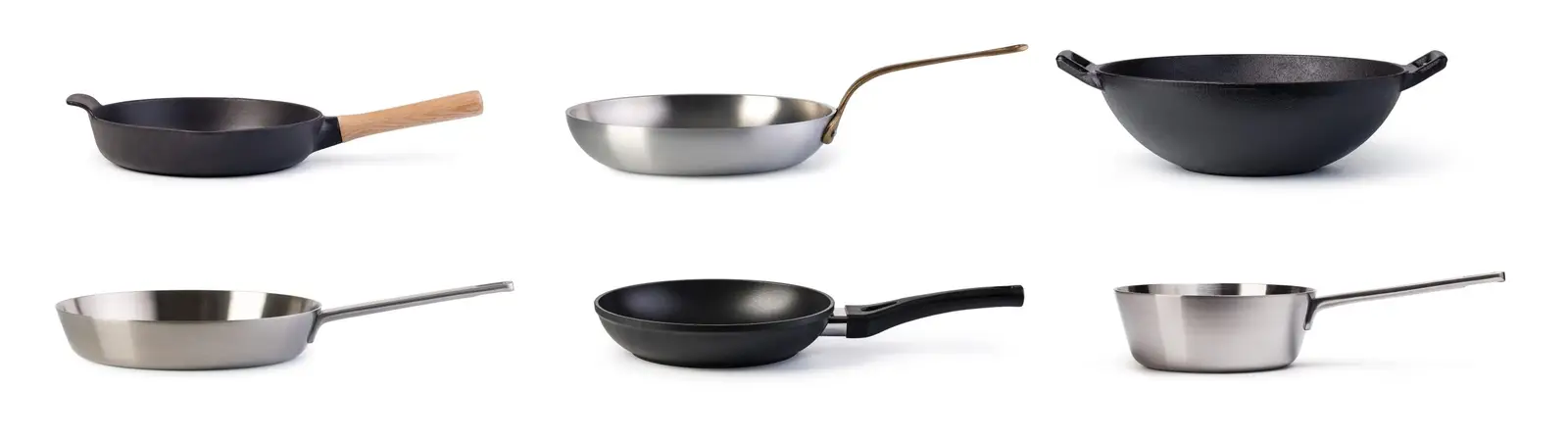
| Cast iron | Yes | Excellent heat retention and very even distribution once up to temperature. Slow to heat initially but holds temperature well — ideal for searing, braising, and anything requiring sustained even heat. Heavy. Can produce buzzing on induction due to its coarse grain structure, but the mass damps vibration. The rougher base of raw cast iron can scratch glass-ceramic — lift rather than slide. | |
| Enamelled cast iron | Yes | Same thermal characteristics as raw cast iron with a smooth enamel coating that is gentler on the glass surface. Non-reactive to acidic foods. Heavier than raw cast iron due to the enamel layer. Vitreous enamel can chip if dropped or subjected to thermal shock — avoid placing a cold enamelled pan on a hot zone. | |
| Carbon steel | Yes | Lighter than cast iron with faster heat response. Ferromagnetic throughout. Requires seasoning to build a non-stick surface and is reactive to acidic foods until well-seasoned. Excellent for woks, crepe pans, and high-heat cooking. Heats more quickly than cast iron and responds faster to power changes — closer to induction’s natural responsiveness. | |
| Magnetic stainless steel (18/0) | Yes | 18/0 stainless (18% chromium, 0% nickel) is ferritic and magnetic. The standard material for induction-compatible stainless cookware. Durable, non-reactive, easy to clean. Does not heat as evenly as cast iron without a copper or aluminium core — clad or tri-ply construction significantly improves heat distribution. | |
| Tri-ply / fully clad stainless | Yes | A magnetic stainless exterior bonded to an aluminium or copper core with magnetic stainless inner. The core distributes heat far more evenly than single-layer stainless. Best of both worlds — induction compatible and excellent cooking performance. Premium option with premium price. | |
| Enamelled steel | Yes | A steel core (ferromagnetic) beneath an enamel exterior. Works on induction if the base is flat and the steel is sufficiently thick. Lighter than cast iron alternatives. Quality varies widely — thin enamelled steel can produce uneven heating. Check the base thickness before buying. | |
| Aluminium with induction disc | Depends | Pure aluminium is not ferromagnetic. Many non-stick pans bond a small ferromagnetic disc to the base to make them induction-compatible. The disc activates the zone but only covers part of the base — heat distribution is less even than a fully ferromagnetic base. Often the source of buzzing or vibration noise on induction. The disc size relative to the coil area affects performance significantly. | |
| Non-magnetic stainless (18/10) | No | — | 18/10 stainless (18% chromium, 10% nickel) is austenitic and not reliably ferromagnetic. Much premium cookware uses 18/10 for its corrosion resistance and appearance — the magnet test will often confirm it will not work. Some manufacturers add an induction-compatible base plate to 18/10 pans; check for the induction symbol or use the magnet test. |
| Pure aluminium | No | — | Not ferromagnetic under any circumstances. Will not activate an induction zone regardless of size, shape, or thickness. |
| Copper | No | — | Not ferromagnetic. An excellent conductor but completely incompatible with induction without a separate bonded base layer. Some specialist copper pans have a stainless induction base added — these will work but may not distribute heat with the same evenness as a pure copper pan on a gas hob. |
| Glass and ceramic | No | — | Non-magnetic and unsuitable for induction cooking under any circumstances. |
What Makes a Good Induction Pan Base
Compatibility gets the coil to activate. Base quality determines how well the heat is distributed and how efficiently the electromagnetic energy is converted. Three base characteristics matter most.
Flatness
The base must be perfectly flat to make full, even contact with the glass surface. A warped or convex base reduces the contact area, which reduces the efficiency of electromagnetic coupling and creates uneven heating. A new pan should have a demonstrably flat base — place it on a flat surface and confirm no rocking. Pans can warp from thermal shock over time (rapid cooling of a hot pan).
Full base coverage
The ferromagnetic material should cover the full base area rather than being confined to a small central disc. A full-coverage base distributes induction heating across the entire pan base; a small disc concentrates the heat at one point and lets the edges run cooler. When buying, check whether a non-stick pan’s induction compatibility comes from a full base or a bonded disc.
Sufficient thickness
A thin base heats unevenly and develops hot spots at the centre of the coil’s strongest field. A thicker base distributes the heat more evenly before it reaches the cooking surface. For everyday cooking, a base thickness of at least 3mm is a reasonable minimum — cast iron and quality stainless clad pans typically exceed this comfortably.
Diameter match
A pan whose base diameter closely matches the zone circle ensures the electromagnetic field is efficiently coupled across the full base area. A very small pan on a large zone, or a large pan that significantly overhangs the zone, both produce less efficient heating. Most induction hobs with flex zones can adapt to different pan sizes — but a well-matched pan is still more efficient.
Pan base quality also affects noise. A lightweight pan with a small bonded induction disc vibrates more than a heavy cast iron pan on the same zone at the same setting — the disc resonates against the aluminium body. If induction hob noise is a concern, the guide to induction hob noise covers which pan characteristics produce more or less sound in detail.
What to Do with Your Existing Cookware
Switching to induction does not necessarily mean replacing your entire pan collection. Work through this audit before buying anything new.
Pan compatibility audit
Most households switching from gas or ceramic find that their cast iron, carbon steel, and most stainless pans transfer directly to induction. The pans most likely to need replacing are lightweight aluminium non-stick pans without an induction disc — and these are typically the least expensive items in a pan collection to replace.
For a full guide to getting the most from an induction hob — including power settings, zone sizing, and everyday cooking tips — see the ultimate induction hob beginner’s guide. For the effect of pan choice on cooking delicate sauces, the guide to delicate sauces on induction covers heavy-base pan selection and temperature control in detail. Browse the CATA induction hob range for models across 60cm and 90cm formats.
Common questions answered
Can I use an induction adapter disc with non-compatible pans?
Yes — an induction adapter disc (a flat ferromagnetic plate placed on the hob surface) allows non-compatible pans to be used. The disc heats up from the coil and transfers heat to the pan above. The efficiency is lower than a compatible pan placed directly on the coil, and the instant-response advantage of induction is largely lost since you are introducing a thermal mass between coil and pan. It is a useful temporary solution when waiting for replacement pans rather than a long-term substitute.
Does the induction symbol guarantee good performance?
It guarantees the pan will activate the zone — it does not guarantee cooking performance. A pan with a small bonded induction disc carries the induction symbol but heats less evenly than a pan with a full ferromagnetic base. Look at base construction details beyond the symbol when buying new cookware for induction.
Why does my induction-compatible non-stick pan buzz or vibrate?
The buzzing almost always comes from the bonded induction disc vibrating against the aluminium body of the pan in response to the alternating electromagnetic field. It is more pronounced with lighter pans and at higher power settings. It is not a fault with the hob. Switching to a heavier pan — cast iron or thick-base stainless — on the same zone at the same setting will typically eliminate the sound. The induction hob noise guide covers this in detail.
Is it worth investing in tri-ply or fully clad stainless for induction?
For everyday cooking, yes — the difference in heat distribution between single-layer magnetic stainless and tri-ply is noticeable for anything that requires even heat across the full base. For tasks like searing and high-heat frying, cast iron or carbon steel may outperform tri-ply stainless at a lower price. The best approach is to have a good heavy-base frying pan in cast iron or carbon steel for high-heat work, and tri-ply stainless for saucepans and sauté pans where even, controlled heating matters most.