What Size Integrated Dishwasher Do I Need?
Most integrated dishwashers come in two practical sizes: 60cm wide (full-size) and 45cm wide (slimline). The right choice depends on the space in your kitchen cabinet, the size of your household, and how often you run it. Getting the measurements right before you buy avoids a much more expensive problem at the installation stage.

The Three Size Options
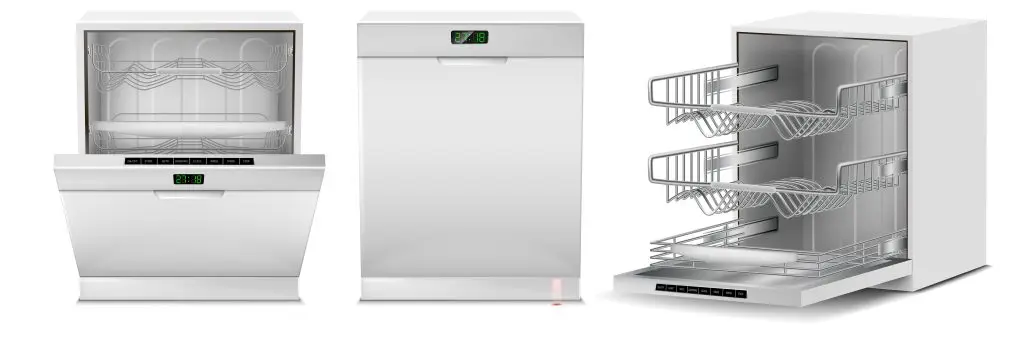
Integrated dishwasher sizing follows a consistent UK standard. Width determines cabinet compatibility; height and depth vary slightly between models but almost always fall within the ranges below. The compact tabletop format is less common and suited to specific situations rather than typical kitchen installations.
Full-size
The UK standard
Fits a standard 600mm base unit. Right for households of three or more, or anyone who cooks regularly and wants to run one full load per day.
The most widely available format with the broadest range of models, features, and price points.
Slimline
Compact kitchens
Fits a 450mm base unit. The sensible choice for one or two people, galley kitchens, or anywhere a full-size unit simply will not fit.
More limited model availability than full-size, but all major manufacturers offer at least one slimline integrated option.
Compact
Specific use cases
Designed for worktop or under-counter installation where height is restricted — studio flats, granny annexes, or caravans with a proper kitchen area.
Not a standard kitchen cabinet fit; requires specific installation planning.
How to Measure Your Space
Measuring for an integrated dishwasher is more involved than measuring the cabinet opening. Three dimensions matter, and each has its own trap for the unwary.
Measure width between the inside faces of the cabinet walls, height from the finished floor to the underside of the worktop, and depth to the back wall minus space for connections.
Width
Measure between the inside faces of the cabinet walls at the front, middle, and back of the opening — older kitchens are not always perfectly square. Use the smallest measurement. A full-size dishwasher needs approximately 598mm of clear width; a slimline needs approximately 448mm. The appliance is designed to slide in with a few millimetres of clearance on each side.
Height
Measure from the finished floor surface to the underside of the worktop. Most integrated dishwashers have adjustable feet that provide around 20mm of height variation, giving a working range of roughly 820mm to 870mm. If your floor-to-worktop measurement falls outside this range, check the specific model’s adjustment capability. Worktops that are slightly lower than standard — common in some older kitchens — can prevent the dishwasher from fitting without modification.
Depth
A dishwasher body is typically 550 to 600mm deep, but the plumbing connections and power cable at the rear add another 50 to 80mm behind the appliance. Measure from the front of your cabinet opening to the back wall and subtract 70mm to find your usable depth. If the result is less than 560mm, the dishwasher will protrude forward of the cabinet face — check that this will not obstruct adjacent doors or drawers when open.
Plinth clearance
The plinth at the base of kitchen units is often a separate removable strip. The dishwasher’s door needs to swing open past the plinth without catching it. Most models require 50 to 60mm of clearance below the door hinge point. Check that the plinth cut-out in your unit is large enough, or that the plinth can be removed and recut to fit.
Allow extra space at the sides
Building regulations and most manufacturers recommend a minimum 2mm gap on each side of an integrated dishwasher for thermal expansion and ease of removal in the event of a fault. A tightly wedged appliance that has to be destroyed to extract it is an expensive problem. If the cabinet is slightly wider than the appliance, packing pieces can fill the gap and prevent the machine from shifting.
Which Size Suits Your Household?
Cabinet space determines what will physically fit, but household size and cooking habits determine which size you will be happiest with in practice. Select your household below.
Single occupant
A slimline 45cm dishwasher with 9 to 10 place settings is more than enough for one person. Running a full-size machine at half capacity wastes water and energy on every cycle. If your kitchen has the space and you cook for guests regularly, a full-size model is still a reasonable choice, but the slimline is the efficient default.
Consider whether you would realistically run a full load daily — if not, a slimline will serve you better and costs less to run.
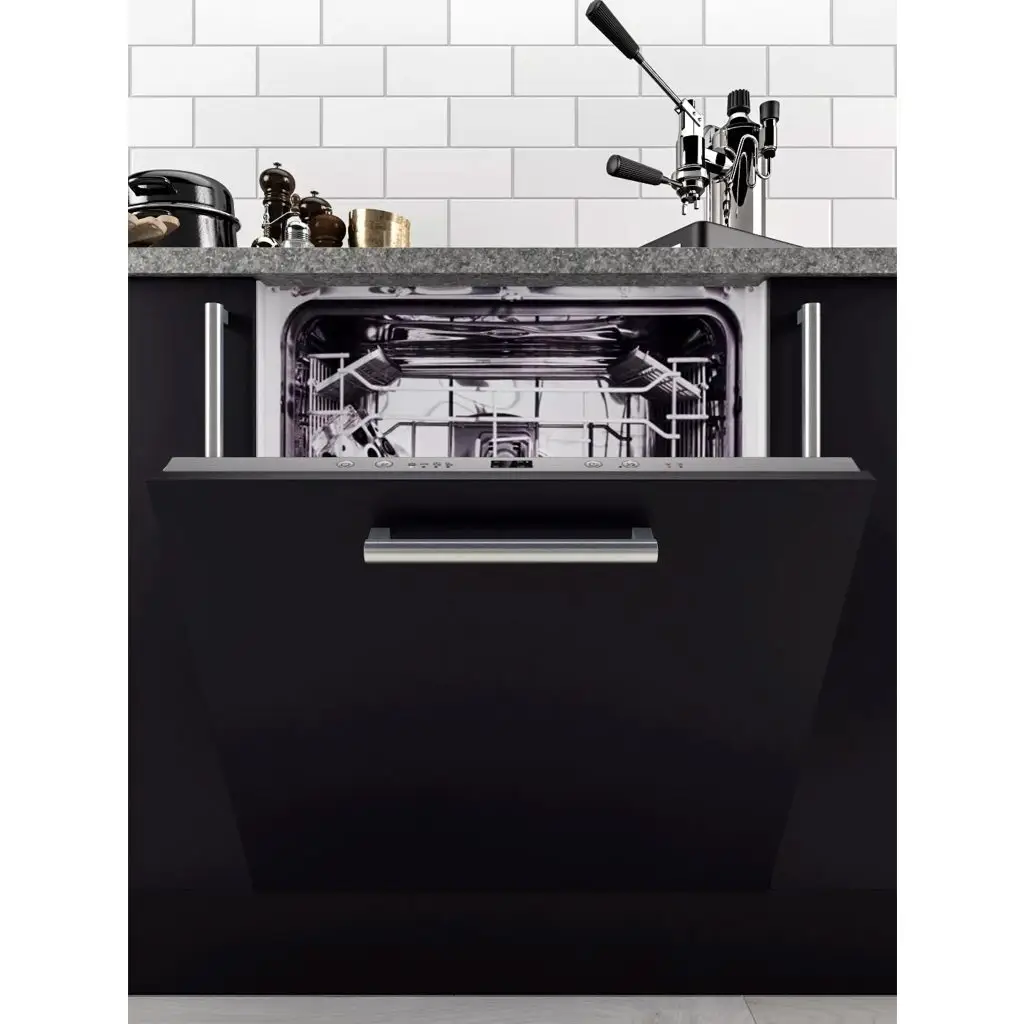
CATA 300 — UBMD60M.1 60cm Integrated Dishwasher
A full-size fully integrated dishwasher with 14 place settings, energy rating C, and five programmes including eco and intensive. Fits a standard 600mm base unit. Available for delivery and professional installation across the UK.
View CATA dishwashersInstallation Pitfalls to Avoid
Most integrated dishwasher installation problems are predictable and entirely avoidable with a few checks before the appliance arrives. These are the ones that come up most often.
Worktop height outside the adjustment range
Older kitchens sometimes have worktops installed at non-standard heights. If the floor-to-worktop measurement is below 815mm or above 895mm, a standard integrated dishwasher will not fit without modifications. Measure this before purchasing — it is not always visible by eye.
Cabinet door misalignment
The furniture door panel must be ordered to the correct height for the specific dishwasher model. Using a door from a previous dishwasher or ordering by eye rather than from the installation manual frequently results in gaps at the top or bottom, or a panel that cannot be fixed to the brackets correctly.
Insufficient depth for connections
The water inlet, waste outlet, and power cable all need to route through the back of the cabinet. If the cabinet back panel is solid and close to the wall, there may not be enough room. In most cases the back panel can be drilled or cut, but this needs to be planned before installation day.
Adjacent door or drawer obstruction
When the dishwasher door opens, it swings down and outward. Check that it will clear the open doors of adjacent units, any drawer that pulls out beside it, and the handle of an opposing unit if the dishwasher is in a galley layout. A door that catches against neighbouring furniture every time it opens is a daily frustration.
Plumbing access too far away
A dishwasher needs a water inlet connection and a waste outlet within practical range. The supplied inlet hose is typically 1.5 to 2 metres; the waste hose is usually around 1.5 metres. If the nearest plumbing is further away than this, an extension hose or replumbing will be needed. Check distances before purchasing.
No accessible socket nearby
An integrated dishwasher plugs into a 13A socket inside the adjacent cabinet, not a visible wall socket. If there is no socket in the cabinet next to the installation position, an electrician will need to fit one before the appliance arrives. This is a straightforward job but requires planning ahead.
Once you have confirmed your dimensions, the guide to fitting an integrated dishwasher door panel covers the bracket system, door height measurement, and alignment process in detail. CATA’s full range of integrated dishwashers includes both 60cm and 45cm models with installation dimensions on each product page.