What Does “Frost-Free” Mean for a Freezer?
A frost-free freezer automatically prevents ice from building up inside the compartment. It does this through a built-in defrost cycle that runs periodically, melting any frost before it can accumulate into the thick ice layers that eventually reduce efficiency and require manual removal. The result is a freezer you never need to defrost yourself.
Why frost forms in the first place
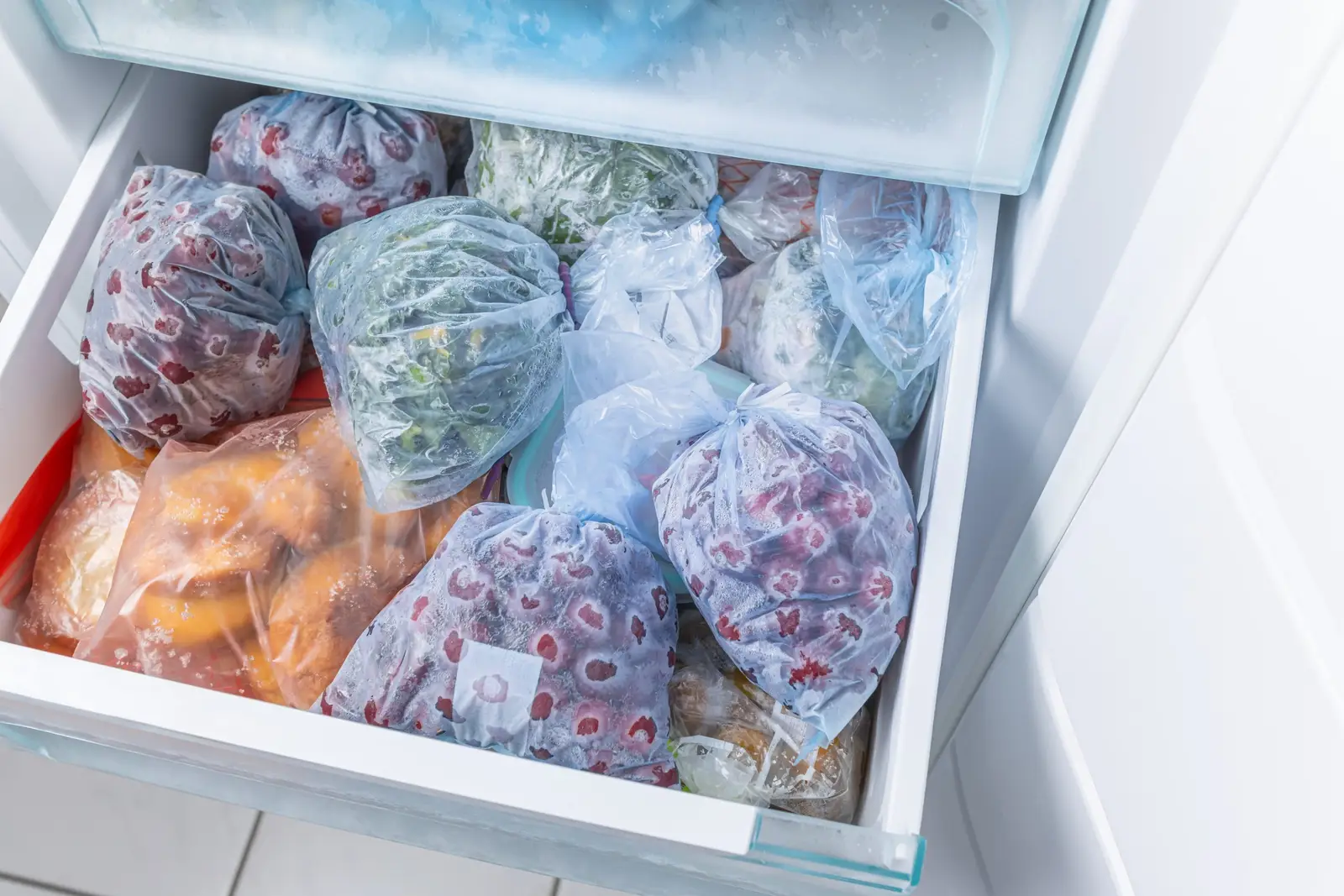
Every time you open a freezer door, a small amount of warm, humid room air enters the compartment. When that moisture-laden air contacts the cold surfaces inside (the walls, the shelves, the evaporator coils at the back), the water vapour freezes on contact and forms a thin layer of frost. Open the door frequently, or leave it open for longer than necessary, and the frost builds faster.
In a traditional manual-defrost freezer, this frost accumulates continuously over weeks and months until it forms a thick layer of ice. That ice acts as insulation around the evaporator coils, forcing the compressor to work harder to maintain temperature. The freezer becomes less efficient, uses more energy, and eventually needs to be switched off, emptied, and defrosted manually before it can work properly again.
How the frost-free system works
A frost-free freezer has a small heating element near the evaporator coils and a fan that circulates air throughout the compartment. Every several hours, the system runs an automatic defrost cycle: the heater briefly warms the coils to just above freezing, melting any frost that has formed. The resulting water drains through a small channel to an evaporation tray at the back of the appliance. The fan then redistributes cool air to bring the compartment back to the set temperature. The whole cycle takes around 20 to 30 minutes and happens automatically, without any user involvement.
Because frost never accumulates, the evaporator coils remain clear and the compressor only has to work as hard as the actual heat load requires. Cooling efficiency stays consistent over the full lifetime of the appliance without any intervention.
Frost-free vs NoFrost: is there a difference?
In practice, these terms describe the same technology. “Frost-free” and “NoFrost” (or “No Frost”) are used interchangeably by different manufacturers to describe a freezer with an automatic defrost cycle. Some manufacturers use “NoFrost” as a brand name for their specific implementation, but the underlying mechanism is the same: a heater, a fan, and a timed or sensor-controlled defrost cycle.
A related but distinct term is “Total No Frost” in fridge-freezers, which applies the same automatic defrost system to both the fridge and freezer compartments. A standard frost-free or NoFrost label on a fridge-freezer typically means only the freezer compartment is frost-free; the fridge section may still require occasional manual wiping.
Frost-free vs manual defrost compared
| Feature | Frost-free | Manual defrost |
|---|---|---|
| Defrosting required | Never — fully automatic | Yes — typically once or twice per year |
| Long-term efficiency | Consistent throughout the appliance’s life | Decreases as frost builds; recovers after defrosting |
| Energy use | Slightly higher due to periodic heating cycles | Lower when well-maintained; higher as frost builds |
| Food drying risk | Minor — fan circulation can dry unwrapped food | Lower — still, moist air; less drying effect |
| Maintenance effort | Minimal — wipe seals and vents occasionally | More involved — periodic full defrost required |
| Best suited to | Everyday households, frequent use, convenience | Long-term bulk storage with minimal door opening |
The slight food-drying effect of frost-free freezers is easy to mitigate: wrap or seal food before freezing. Unsealed food left in a frost-free freezer for extended periods can develop surface freezer burn faster than in a manual-defrost model, but this is a packaging issue rather than a fundamental limitation of the technology.
Is frost-free worth the modest energy premium?
For most households, yes. The time and effort of manually defrosting a freezer once or twice a year (emptying the contents, leaving it switched off for hours, cleaning up the melt water, and refilling) is a meaningful inconvenience. Frost-free eliminates it entirely. The energy premium for the periodic heating cycles is real but small: typically 5 to 15 percent higher consumption than an equivalent manual-defrost model. Given that a modern frost-free freezer is an A-rated appliance running at 15 to 20 kWh per year, the difference in absolute cost is a few pounds annually.
The only scenario where manual defrost makes more practical sense is a dedicated chest freezer used for bulk long-term storage, opened infrequently, in a cool outbuilding. In that use case, frost accumulates more slowly and the infrequent opening means the convenience argument for frost-free is weaker. For an integrated kitchen freezer or fridge-freezer in everyday use, frost-free is the straightforward choice. For more on keeping running costs low across all kitchen appliances, see the kitchen appliance running costs guide.
Browse the CATA freezer range and fridge-freezer range for frost-free and Total No Frost models. For guidance on fridge and freezer noise during normal operation, the fridge humming noise guide explains the sounds the defrost cycle and compressor make during normal use.
Common questions answered
Does a frost-free freezer ever need defrosting?
No, under normal use. The automatic cycle handles frost removal continuously. If the door seal fails or is left open for an extended period, frost can occasionally accumulate faster than the cycle can manage, but this is a maintenance issue (replace the seal) rather than a limitation of the frost-free system itself.
Why does my frost-free freezer have a brief warm period occasionally?
This is the automatic defrost cycle running normally. The heating element warms the evaporator coils for 20 to 30 minutes to melt any frost. The temperature in the food storage area does not rise significantly during this time as the heat is localised to the coils. The compressor then brings the compartment back to the set temperature once the cycle is complete.
Is “NoFrost” the same as “frost-free”?
Yes. The two terms describe the same automatic defrost technology. Different manufacturers use different marketing names for identical functionality. “Total No Frost” on a fridge-freezer means the system applies to both compartments; standard “frost-free” or “NoFrost” on a fridge-freezer typically refers to the freezer section only.
Does frost-free affect how I should store food in the freezer?
One practical difference: the fan circulation in a frost-free freezer can dry out the surface of unwrapped food more quickly than in a manual-defrost model. Wrapping food properly in freezer bags or airtight containers before freezing prevents this entirely and is good practice regardless of freezer type.