Home » Cooker Hood Guides & Advice » The Pros and Cons of Angled vs Chimney Cooker Hoods
Angled vs Chimney Cooker Hoods: Pros, Cons and How to Choose
Angled and chimney cooker hoods are the two most common wall-mounted types. Both mount above the hob and extract in the same fundamental way, they differ meaningfully in design profile, head clearance, extraction capacity, and how they sit in a kitchen visually. The right choice depends on ceiling height, cooking habits, kitchen style, and how much visual space the hood should occupy.
Side-by-side comparison
| Feature | Angled hood | Chimney hood |
|---|---|---|
| Design profile | Slim, tilted glass or steel front | Canopy with vertical flue — more presence |
| Head clearance | Excellent — tilted front creates more room | Moderate — flat underside sits closer to eye level |
| Typical extraction | Moderate to strong | Typically stronger at larger sizes |
| Noise at equivalent speed | Often slightly quieter | Can be louder at peak airflow |
| Cleaning effort | Less — fewer surfaces, wipeable glass | More — canopy underside, baffle filters, flue |
| Visual impact | Understated, modern | Bold, focal point quality |
| Best ceiling height | Low to standard (2.1m+) | Standard to high (2.4m+) |
| Available widths | Typically 60–90cm | 60cm to 120cm+ |
Angled Cooker Hoods
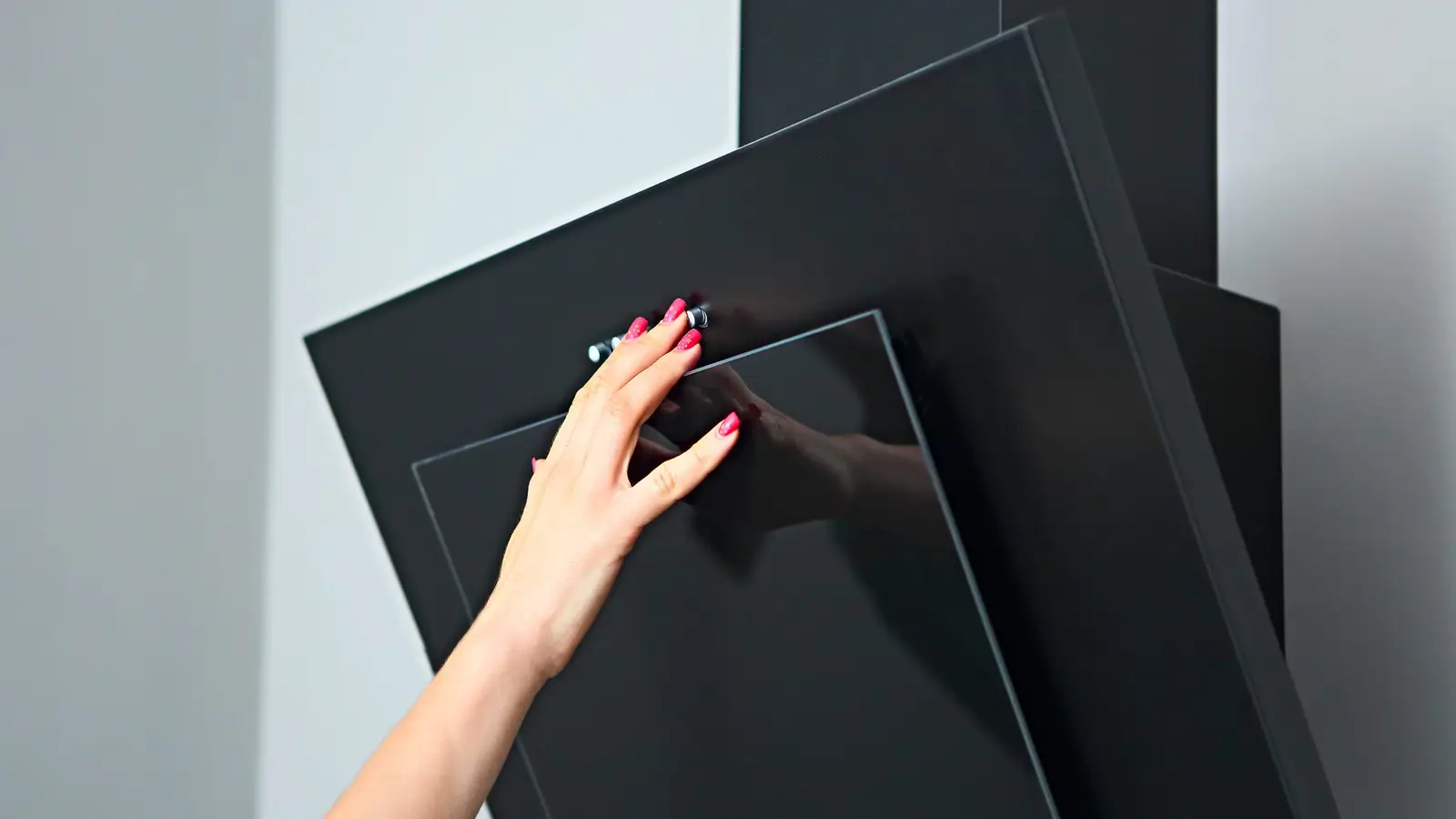
An angled hood has a forward-sloping front — usually glass or brushed steel — that projects toward the cook rather than hanging flat beneath the cabinet. The slope serves a practical purpose: it positions the intake grille closer to the cooking surface without the hood sitting as low at the front, which means more comfortable working clearance at the hob.
Angled hoods suit compact kitchens and low ceilings well. Because the flue section is typically slimmer than on a chimney model, they occupy less visual space on the wall. The glass or steel surface wipes clean easily; there are fewer right-angle crevices to accumulate grease compared with the squared underside and canopy corners of a chimney hood.
The trade-off is extraction capacity. The motor and fan assembly in an angled hood is typically smaller than in a similarly priced chimney model, which can limit peak airflow at the highest speed setting. For light to moderate cooking (everyday meals, occasional frying), this is not a practical issue. For households that cook heavily or fry frequently, a chimney hood at equivalent price often delivers more extraction headroom.
Angled: Pros
- Excellent head clearance at the hob
- Slim profile suits low ceilings and compact kitchens
- Modern, understated aesthetic
- Easy to clean — glass or steel wipes clean
- Often quieter at comparable extraction rates
Angled: Cons
- Peak extraction typically lower than chimney equivalents
- Fewer very wide models (100cm+)
- Some designs have a smaller grease filter area
Chimney Cooker Hoods
A chimney hood has a horizontal canopy that sits flat beneath the wall cabinets, with a vertical flue rising from the canopy to the ceiling or soffit. The canopy collects steam and vapour rising from the hob; the flue channels it to an external duct or through recirculation filters. The design is architecturally prominent. The vertical flue makes a feature of the extraction system rather than minimising it.
Chimney hoods are available in a wider range of sizes than angled hoods, including 90cm, 100cm, and 120cm widths that suit larger hobs or range cookers. At these wider sizes, the canopy’s collection area is significantly larger, which improves capture efficiency for steam and cooking odours that spread more widely before they are captured. For households with five or six burner hobs or range cookers, a wide chimney hood is often the more practical specification.
The design suits both traditional and modern kitchens — a stainless steel chimney hood is equally at home in a contemporary flat-front kitchen as in a more traditional scheme. Cleaning is more involved than an angled hood: the canopy underside collects grease at the corners and edges, and the baffle or mesh filters need regular maintenance. However, baffle filters are generally dishwasher-safe, which reduces the cleaning effort significantly.
Chimney: Pros
- Strong extraction — suits heavy cooking
- Wide coverage across larger hobs
- Available in widths up to 120cm+
- Design focal point — suits modern and traditional kitchens
- Larger filter area captures more grease
Chimney: Cons
- More visual bulk — dominant in small kitchens
- Lower head clearance at the front edge of the canopy
- More surfaces and corners to clean
- Flue section requires adequate wall height
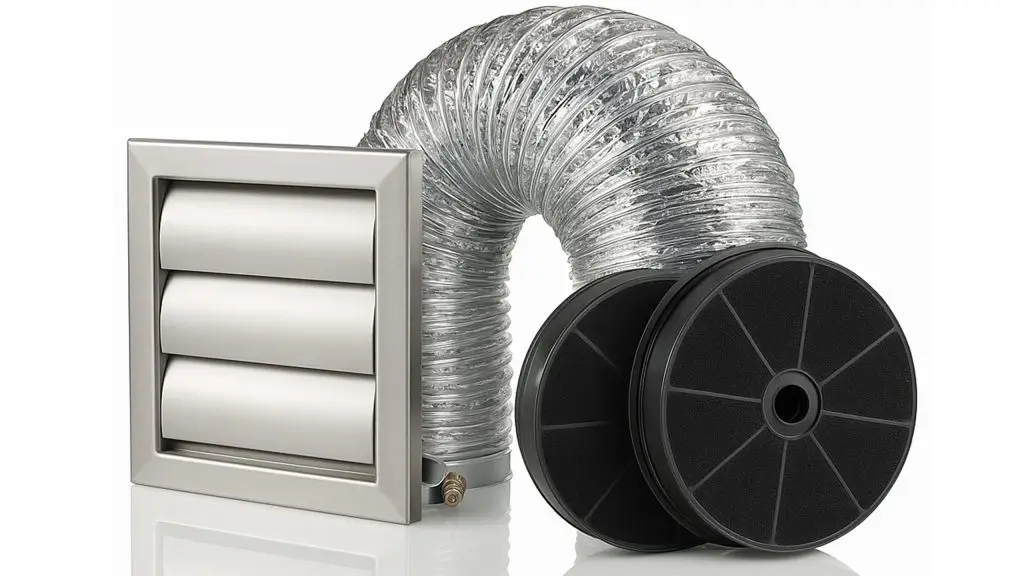
Both angled and chimney hoods can be configured for external ducting or recirculation. External ducting removes moisture and cooking odours entirely; recirculation passes air through carbon filters and returns cleaned air to the kitchen. Ducting is the more effective option where the installation allows it. For more on ducting and extraction performance, see the guide to kitchen ventilation options.
How to Decide
Choose angled if…
Your ceiling is low (under 2.4m), kitchen space is compact, you prefer a less visually dominant hood, or your cooking is light to moderate. Angled hoods are also the practical choice where a chimney flue would dominate a small kitchen wall.
Choose chimney if…
You have a wider hob (90cm+) or range cooker, cook frequently at high heat, want the hood to make a visual statement, or have the ceiling height to accommodate the flue without the canopy sitting uncomfortably low.
Size the hood to the hob
The hood should be at least as wide as the hob — ideally wider. A 60cm hood over a 90cm hob leaves the outer burners uncovered. A 90cm hood over a 60cm hob provides better capture at the edges. Match or exceed the hob width when specifying.
Check installation height
Both types require a minimum installation height above the hob — typically 65cm for electric hobs and 75cm for gas. Check the specific model’s installation guide before ordering, particularly in kitchens with low wall cabinets.
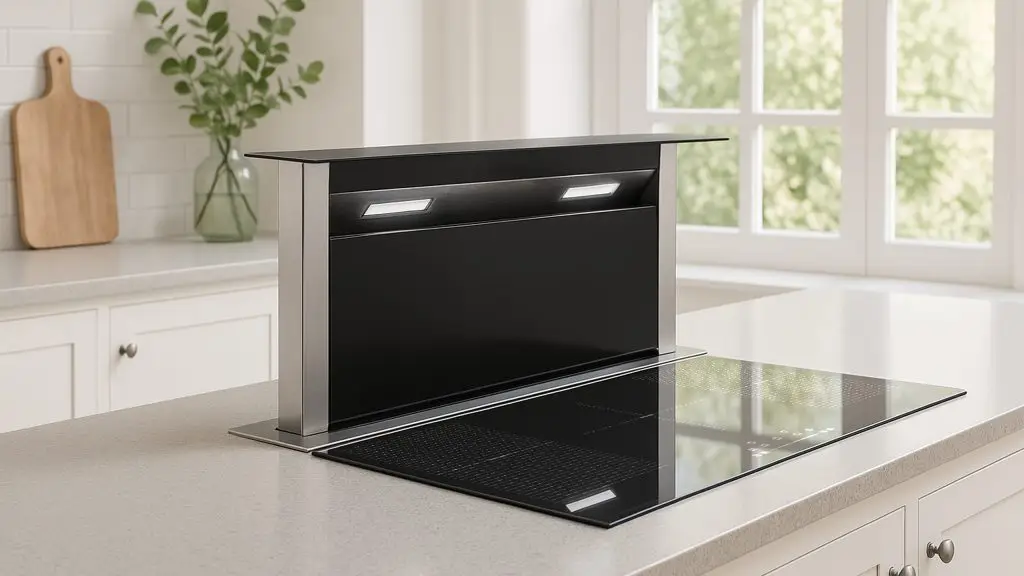
Browse the CATA angled glass cooker hood range and chimney cooker hood range for current models across 60cm and 90cm widths. For households considering an island or peninsula layout, the vented induction hob guide covers downdraft extraction as an alternative to any wall-mounted hood.
Common questions answered
Do angled hoods extract as effectively as chimney hoods?
At equivalent price points, many angled models perform comparably for everyday cooking. Chimney hoods tend to offer higher peak extraction at the top end of their speed range, particularly in wider sizes. For light to moderate cooking, an angled hood is typically sufficient. For frequent high-heat cooking or a wide hob, a chimney model offers more headroom.
Can I fit a chimney hood on a low ceiling?
It depends on the specific model and ceiling height. A chimney hood needs enough wall height above the hob to accommodate the canopy at the correct installation height and then the flue rising to the ceiling. In kitchens with ceilings below 2.3m, the flue section may be too short to look proportionate, or the canopy may sit uncomfortably close to eye level. An angled hood is the more practical choice in these situations.
Are chimney hoods always louder than angled hoods?
Not necessarily at equivalent extraction rates. At comparable m³/h settings, noise levels are similar. The perception that chimney hoods are louder often comes from comparing them at their respective maximum speeds, where a larger chimney motor running at peak capacity moves more air and therefore produces more noise than a smaller angled hood motor at its maximum.
Which type is easier to clean?
Angled hoods generally have fewer surfaces to clean. The sloping glass or steel front wipes down easily, and the grease filter is straightforward to access. Chimney hoods have a canopy underside, side panels, and a flue section that all accumulate grease over time. Both types have removable filters that are typically dishwasher-safe — the difference is the additional fixed surfaces on a chimney model that require manual wiping.
Explore More Kitchen Advice & Buying Guides
Browse our latest articles covering appliance tips, energy-saving advice, and expert guidance – designed to help you choose, use, and get the most from your kitchen appliances.